Industry 4.0 manufacturing is a critical capability for modern warehouse and supply chain operations. In manufacturing it gets discussed in sweeping, abstract terms – cyber-physical systems, autonomous factories, digital twins. But if you run a plant or manage operations at a mid-size manufacturer, the reality is more grounded. You’re deciding whether to replace paper travelers with tablets, connect your CNC machines to something other than an operator’s clipboard, or stop building next week’s production schedule in a spreadsheet emailed at 6 a.m.
Those decisions all point in the same direction: toward connected, data-driven operations. That direction has a name, and it’s Industry 4.0. The framework matters less than what it enables – real-time visibility into what’s actually happening on your shop floor, and the ability to act on that information before problems compound.
This guide translates manufacturing 4.0 from concept into operational reality. We’ll cover the four technologies that actually change how a shop floor runs, where MES and WMS fit into the picture, and what a practical starting point looks like for a manufacturer who wants results in months, not years.
What Is Industry 4.0?
Industry 4.0 is the fourth industrial revolution, defined by the integration of digital technologies into physical manufacturing operations. The prior three revolutions each had a defining shift: mechanization with steam and water power, electrification and mass production, then automation through computers and programmable logic controllers.
The core distinction of the fourth revolution is real-time data flow between machines, systems, and people. It isn’t just about automating individual tasks – factories have been doing that since the 1970s. What’s different now is connecting the entire operation so that a machine, a work order, a quality check, and an inventory transaction all speak the same language and update the same system of record simultaneously.
It’s not a single technology. It’s a framework that includes IoT, artificial intelligence and machine learning, cloud computing, digital twins, advanced robotics, and additive manufacturing. Not all of these will matter equally to every plant. For most discrete and process manufacturers, four technologies do the heavy lifting.
Take Control of Your Shop Floor
From production scheduling to quality control, ASCTrac MES gives manufacturers the tools to optimize every step.
Request a Demo
The Four Technologies That Matter Most for Manufacturers
Internet of Things (IoT) on the Shop Floor
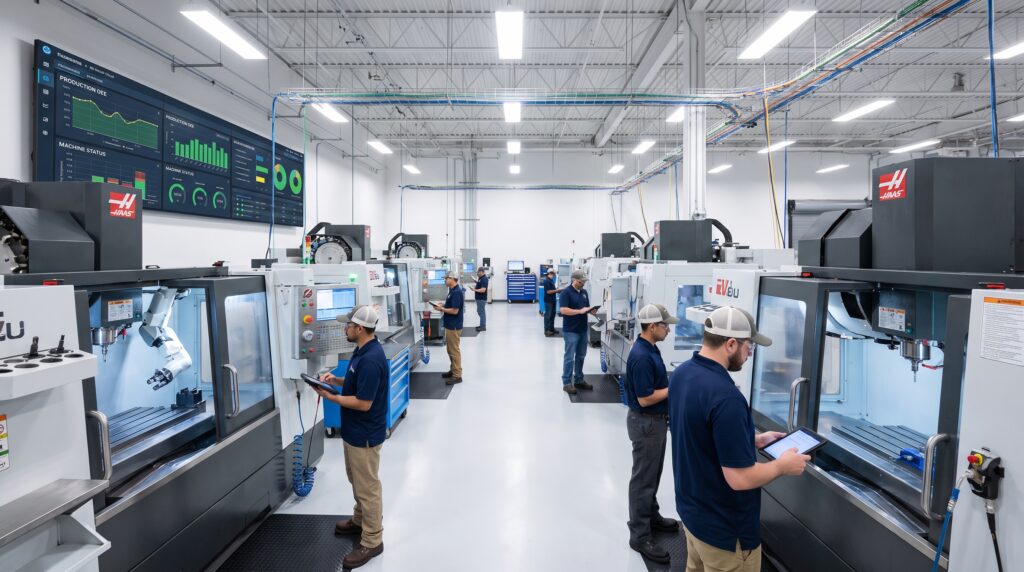
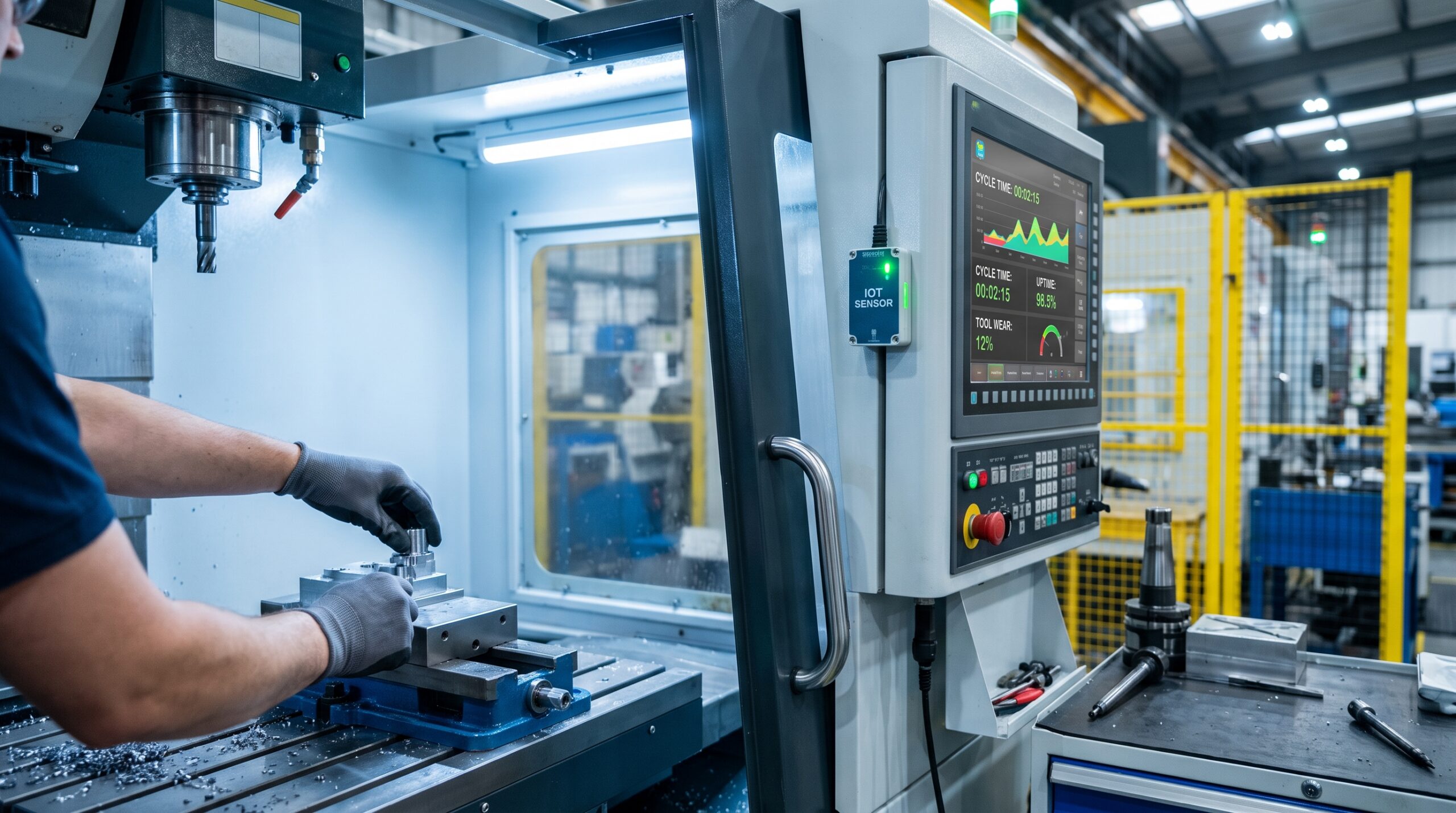
IoT in a manufacturing context means sensors and connected devices that transmit real-time data from machines, conveyors, environmental monitors, and production equipment. Instead of an operator writing down cycle counts at the end of a shift, a connected CNC or injection molding machine reports cycle time, uptime, tool wear, and downtime reasons directly into your production system.
What this actually changes on the floor:
- Overall Equipment Effectiveness (OEE) is calculated from live machine data, not estimated from paper logs
- Unplanned downtime is visible immediately, not at the end-of-shift review
- Energy consumption and environmental conditions (temperature, humidity) are logged automatically
- Manual data collection – the biggest source of error and delay in most plants – is eliminated for connected assets
The entry point for most manufacturers is connecting existing equipment to a data collection layer. You don’t need to replace your machines. Older equipment can be retrofitted with sensors or connected through PLC data taps, and newer machines typically ship with connectivity built in. For a deeper look at how this data gets captured and put to work, see our guide to shop floor data collection and inventory tracking.
Manufacturing Execution Systems (MES)
The MES is the software layer that sits between your shop floor and your ERP, managing production execution in real time. If IoT is the nervous system, industry 4.0 MES is the brain – it collects sensor data, manages work orders, tracks work-in-process, documents quality checks, and provides the dashboards that make everything else actionable.
This is why MES is the operational core of Industry 4.0 for most manufacturers. Without it:
- IoT data has nowhere meaningful to go – you’re collecting signals but not connecting them to work orders, lots, or shifts
- ERP production plans have no feedback loop from the floor – you’re planning based on what should have happened, not what did
- Quality data lives in binders and spreadsheets, disconnected from the process parameters that caused the defect
Many manufacturers already have pieces of an MES – a scheduling tool here, a quality module there, a downtime tracking app somewhere else. The Industry 4.0 shift is integrating them onto one platform where the data lines up. Explore our manufacturing execution system capabilities to see how these pieces fit together.
Artificial Intelligence and Machine Learning
Applied AI in manufacturing is far less exotic than the headlines suggest. The practical applications are specific and increasingly proven:
- Predictive maintenance: models that flag equipment degradation weeks before failure by analyzing vibration, temperature, and cycle data
- Quality defect prediction: identifying which process parameters correlate with rejects, so operators can adjust before scrap accumulates
- Production scheduling optimization: balancing order priority, changeover time, and material availability more effectively than a scheduler can by hand
The realistic adoption path for smart manufacturing is descriptive analytics first (live dashboards showing what’s happening now), then diagnostic (why it happened), then predictive (what will happen next). Skipping to predictive models before you have clean, consistent operational data is where most AI projects fail. That’s another reason MES and IoT come first – they build the data foundation ML needs to actually work.
Cloud-Based Platforms and ERP Integration
Cloud deployment for manufacturing software has moved from novelty to default. WMS, MES, and increasingly ERP systems are hosted in the cloud and integrated through APIs, which changes what’s operationally possible:
- Multi-site visibility without on-premise infrastructure at every plant
- Remote monitoring of production and inventory from anywhere
- Real-time data sharing with customers, suppliers, and 3PLs
- Faster deployment and updates – no on-site server rooms to maintain
The other piece is bidirectional ERP integration. Production data (completions, scrap, labor, machine time) flows up to the ERP; plans, BOMs, routings, and work orders flow down to the shop floor. Manual re-entry disappears. Sync lag disappears. When a customer changes an order, the floor sees it. When the floor reports a shortage, planning sees it.
Security has kept pace. SOC 2 certification, role-based access controls, and encryption in transit and at rest are standard in purpose-built manufacturing software. The old concern about “putting production data in the cloud” has largely been resolved by the same technology stack that banks and healthcare providers rely on.
Industry 4.0 and the Warehouse: Where WMS Fits In
Most Industry 4.0 conversations focus on machines and production, but the warehouse is transformed just as significantly. The WMS is the data layer for receiving, putaway, picking, packing, and shipping. It replaces the manual records, clipboards, and spreadsheets that still run too many warehouses.
Barcode scanning and RFID feed real-time inventory data into the system of record with every transaction. That data becomes reliable in a way weekly cycle counts never could be. And when the warehouse management system shares a data layer with the MES, the compounding effect is significant:
- Raw material availability is visible to production schedulers in real time – no more discovering shortages mid-run
- Finished goods inventory updates the moment production reports completions
- Lot traceability extends unbroken from raw material receipt through production through finished goods shipment
- Inventory accuracy climbs high enough that safety stock buffers can shrink
For regulated industries the stakes are higher. Pharmaceutical manufacturers and food and beverage producers rely on IoT-driven temperature monitoring, automated lot traceability, and electronic documentation to meet FDA, cGMP, and FSMA requirements. Industry 4.0 isn’t optional for these operations – it’s the only realistic way to maintain compliance at scale.
What Industry 4.0 Looks Like in Practice
Consider a mid-size discrete manufacturer running 40 to 60 machines across two shifts, producing to both stock and order. Here’s what changes.
Before (manual and siloed):
- Production schedules are built in Excel and emailed to supervisors each morning
- Machine downtime is recorded on paper logs, reviewed at the end of shift, keyed into a spreadsheet the next day
- Work order status is updated manually – supervisors walk the floor with clipboards to know where things stand
- Inventory counts happen weekly; production often discovers shortages mid-run
- Quality issues are found at final inspection; scrap is tallied at end of day
After (connected):
- The MES pulls production orders directly from the ERP, sequences them based on real-time capacity and material availability, and adjusts when priorities change
- IoT sensors report machine downtime in real time; alerts route to maintenance the moment a stoppage begins
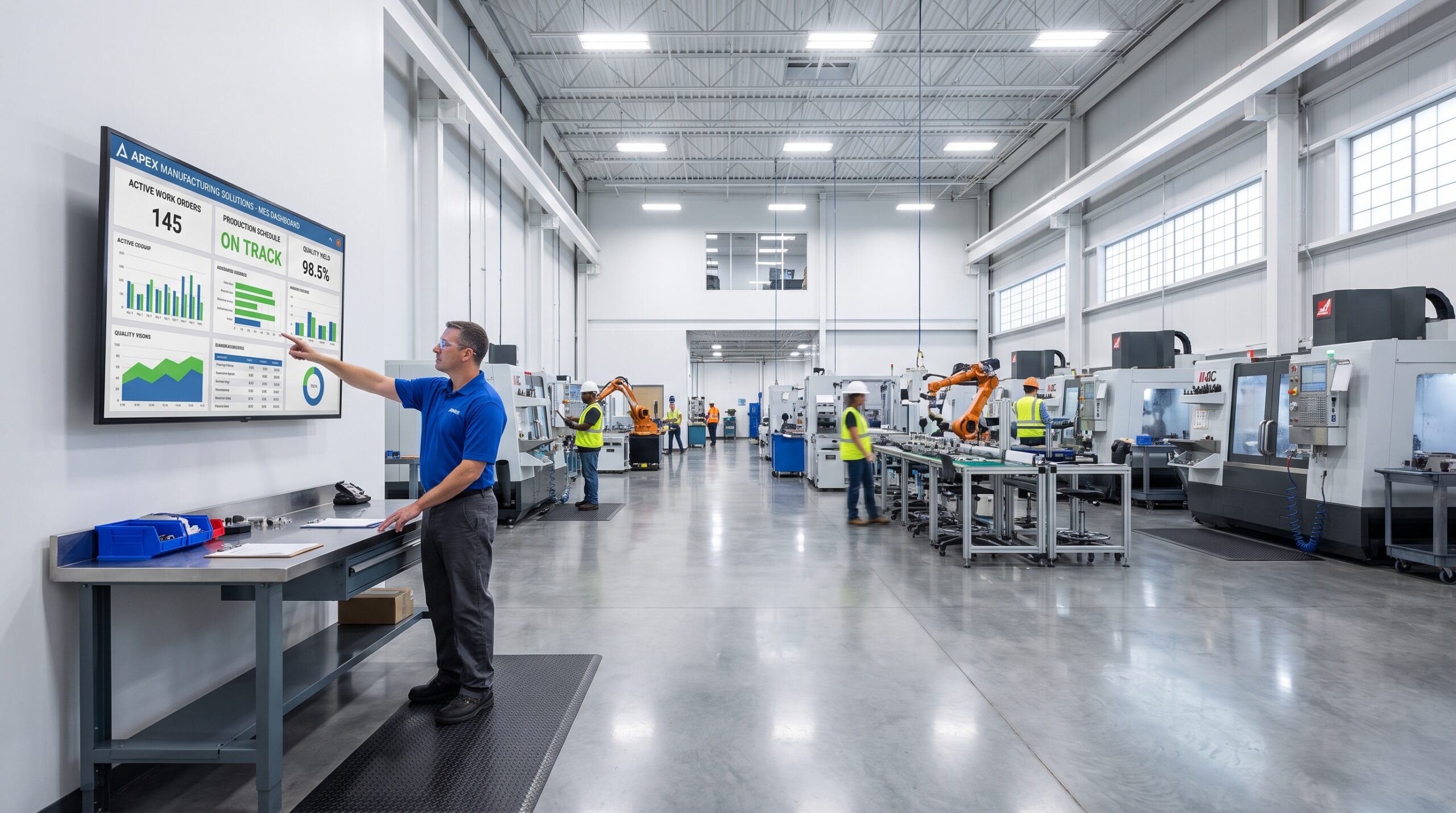
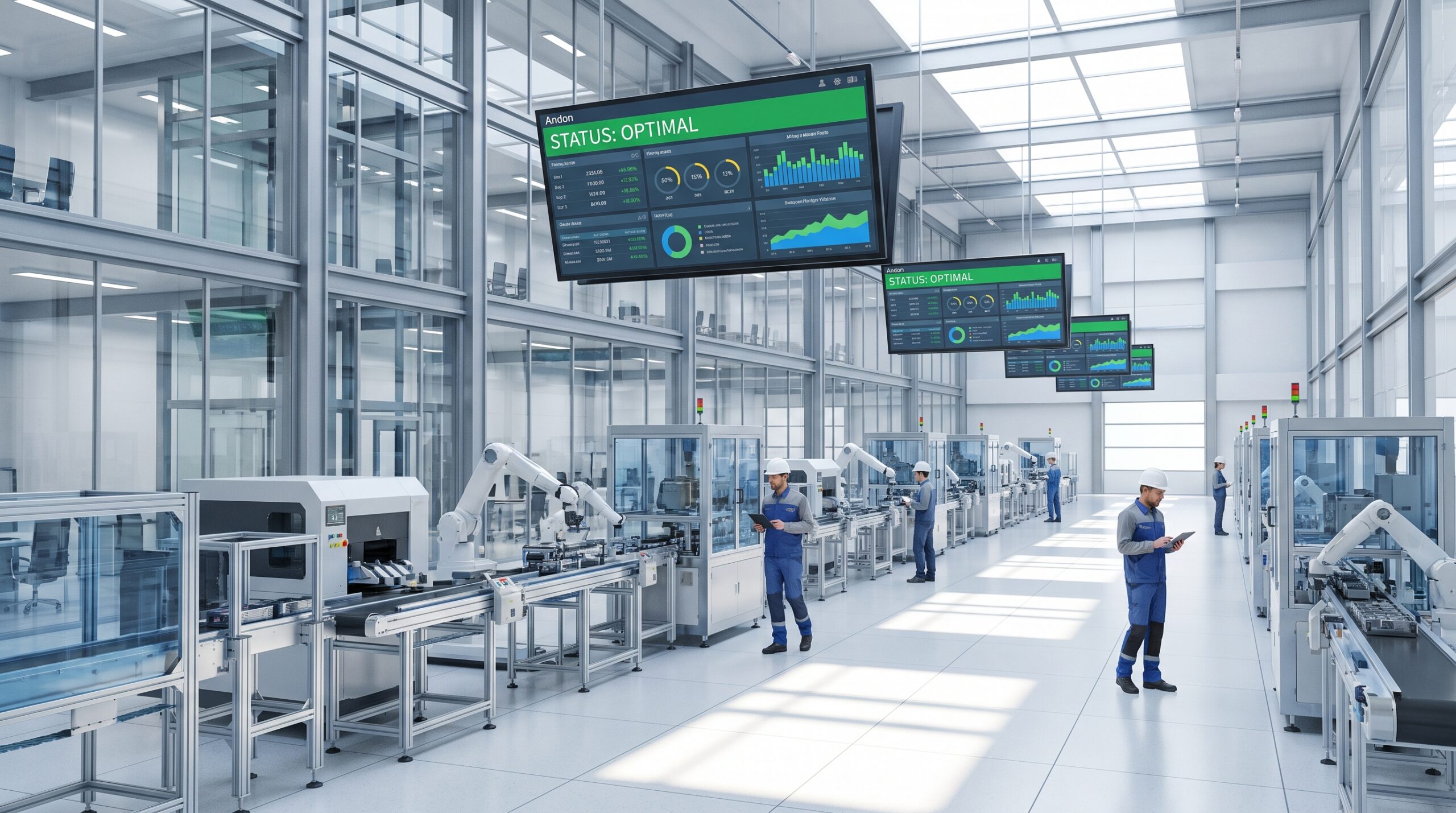
- Work order progress is visible on shop floor dashboards and supervisor tablets continuously – anyone can see WIP status without a walk-around
- WMS inventory updates at every transaction, and material availability feeds directly into production scheduling
- Quality parameters are logged during production; deviations are flagged in real time before they become scrap
None of this requires ripping out existing equipment. Most successful digital manufacturing implementations add a data layer on top of existing assets and integrate the systems that are already in place. The transformation is real, but it isn’t a rip-and-replace project.
Where to Start: A Practical Industry 4.0 Roadmap
The mistake operations teams make is treating Industry 4.0 as a five-year transformation program. It doesn’t have to be. Sequenced correctly, most manufacturers see meaningful results within the first 12 months.
Step 1: Establish the data foundation. You cannot analyze data you are not collecting. Start with MES for production tracking and WMS for inventory. These capture the baseline operational data that everything else builds on. Without them, every subsequent step becomes harder.
Step 2: Connect your systems. Bidirectional ERP integration comes next. Work orders, BOMs, routings, and inventory data should flow between your ERP and your shop floor systems without manual re-entry. This is where you eliminate the swivel-chair integration that eats hours every day.
Step 3: Add IoT connectivity. Connect machines and sensors to your MES. Prioritize the highest-impact assets first – bottleneck equipment and the machines most prone to unplanned downtime. Don’t try to connect everything at once. A phased rollout builds internal expertise and lets you show ROI incrementally.
Step 4: Activate analytics. Once clean, consistent data is flowing, real-time dashboards become genuinely useful. OEE, scrap rates, on-time delivery, first-pass yield – these metrics mean something when they’re based on live data instead of lagging reports assembled from spreadsheets.
Step 5: Move toward predictive. With 12 to 18 months of clean operational data, predictive maintenance and quality models become feasible. This is where ROI on the data foundation really compounds. Downtime shifts from reactive to planned, and quality issues get caught upstream instead of at final inspection.
The sequence matters. Skipping ahead – trying to deploy AI before you have reliable data, or connecting machines before you have somewhere for the data to land – is the fastest way to stall a modernization program.
How ASC Software Supports Industry 4.0 for Manufacturers
ASC Software builds purpose-built MES and WMS for discrete and process manufacturers. Our platform delivers the Industry 4.0 capabilities that operations teams actually need: real-time production visibility, IoT data integration, shop floor tracking, WMS and MES on a single platform, and bidirectional ERP integration.
We serve discrete and process manufacturers, pharmaceutical producers, food and beverage operations, wholesale distributors, and 3PL providers – industries where real-time data and compliance documentation are both required. All software, design, and support are based in the U.S.
If your team is evaluating industry 4.0 for manufacturers as a practical operations initiative rather than an abstract concept, we can help you scope a starting point that delivers measurable results in the first year.
- Request a demo to see ASC Software’s MES and WMS in action
- Explore our full manufacturing and warehouse solutions
- Learn more about our MES platform for discrete and process manufacturers
Frequently Asked Questions
What is Industry 4.0 in simple terms?
Industry 4.0 is the integration of digital technologies – IoT sensors, AI, cloud computing, and connected systems – into manufacturing operations. The defining characteristic is real-time data flow between machines, software systems, and people, enabling manufacturers to monitor, analyze, and optimize operations continuously rather than reactively.
What is the difference between Industry 4.0 and smart manufacturing?
Smart manufacturing is often used interchangeably with Industry 4.0 in a manufacturing context. Industry 4.0 is the broader framework; smart manufacturing describes the outcome – a factory where production processes are connected, data-driven, and continuously optimized. Both terms point to the same technology stack: IoT, MES, cloud ERP, and advanced analytics.
Do small and mid-size manufacturers need to adopt Industry 4.0?
Yes, though the implementation looks different at different scales. Mid-size manufacturers don’t need digital twins or fully autonomous production lines to benefit. Starting with MES for real-time production visibility and WMS for inventory accuracy delivers measurable ROI without significant infrastructure investment. The competitive pressure to modernize applies regardless of company size – customers, auditors, and trading partners increasingly expect digital documentation and traceability.
What is MES and why is it important for Industry 4.0?
A Manufacturing Execution System (MES) is software that manages and monitors production execution in real time, sitting between the shop floor and the ERP. It’s the operational core of Industry 4.0 for most manufacturers because it collects data from IoT-connected machines, manages work orders, tracks WIP, and provides the real-time visibility that enables data-driven decisions on the shop floor.
How does Industry 4.0 improve manufacturing quality?
Industry 4.0 shifts quality management from inspection-based (catching defects at the end) to process-based (monitoring production parameters in real time and flagging deviations as they occur). IoT sensors capture process data continuously; MES links that data to specific lots and work orders; analytics identify correlations between process parameters and quality outcomes. The result: fewer defects, faster root cause analysis, and better documentation for regulatory compliance.
Frequently Asked Questions
What is industry 4.0 manufacturing?
Industry 4.0 manufacturing is the integration of digital technologies into physical manufacturing operations. It marks the fourth industrial revolution, focusing on real-time data flow between machines, systems, and people. Unlike previous revolutions, it’s about connecting entire operations for unified communication. Technologies like IoT, AI, and cloud computing are pivotal in this transformation, enabling real-time visibility and data-driven decision-making on the shop floor.
How does IoT impact industry 4.0 manufacturing?
IoT in industry 4.0 manufacturing involves sensors and connected devices transmitting real-time data. This technology replaces manual data collection, allowing machines to report cycle times, tool wear, and downtime reasons directly. It enhances Overall Equipment Effectiveness (OEE) by providing accurate, timely data for better decision-making. For instance, a connected CNC machine can automatically update production systems, reducing human error and increasing efficiency.
Why is real-time data important in manufacturing?
Real-time data is crucial in manufacturing as it enables immediate visibility into operations. This allows for quick decision-making and problem-solving before issues compound. By connecting machines, systems, and people, manufacturers can synchronize work orders, quality checks, and inventory transactions. Real-time data flow ensures that all elements of production are aligned, enhancing efficiency and reducing downtime across the shop floor.
What technologies define industry 4.0?
Industry 4.0 is defined by technologies like IoT, artificial intelligence, cloud computing, and digital twins. These technologies facilitate the integration of digital systems into manufacturing, enabling real-time data sharing and advanced analytics. They help create autonomous factories with interconnected operations. For example, IoT sensors provide continuous machine data, while AI analyzes this information for predictive maintenance and process optimization.
How can manufacturers start with industry 4.0?
Manufacturers can start with industry 4.0 by implementing connected devices and data-driven systems. Begin by replacing manual processes with digital tools like tablets and IoT-enabled machines. Focus on technologies that provide real-time insights, such as MES and WMS, to optimize operations. Start small with pilot projects to demonstrate value and then scale up. Prioritize technologies that align with specific operational needs for the best results.