
Improving product quality in manufacturing is not a single initiative—it is an ongoing discipline that combines process control, employee training, data analysis, and systematic root-cause investigation to reduce defects and variation over time. Manufacturing leaders face a constant balancing act between speed, cost, and quality, and getting that balance right starts with understanding how to improve quality in manufacturing at every stage of production. Strong quality management in the manufacturing industry depends on more than inspection checkpoints; it requires a culture, a technology stack, and a measurement system that work together. The importance of quality control in manufacturing extends beyond passing audits, since defects ripple into customer churn, recalls, and reputational damage. This guide compares the major approaches to how to improve manufacturing process performance, weighs the tradeoffs of each, and offers practical product improvement ideas you can adapt to your operation.
Rather than promoting a single methodology, this article puts traditional quality programs side by side with modern, technology-driven approaches. You will see where Six Sigma still wins, where AI-driven inspection outpaces manual review, and how customer feedback loops compare with internal continuous improvement models. By the end, you should have a clearer view of which combination of strategies fits your facility, your budget, and your team.
Comparing Approaches to How to Improve Quality in Manufacturing
There is no single path to better products. Some manufacturers double down on statistical process control, others invest heavily in automation, and a growing number combine both with workforce development programs. Each approach carries strengths and limitations, and the right mix depends on product complexity, regulatory exposure, and production volume.
Before comparing tactics, it helps to define the goal. Quality improvement is not just defect reduction. It includes consistency across batches, conformance to specification, durability in the field, and the customer’s perception of value. A program that lowers scrap by five percent but ignores warranty returns has only solved half the problem.
Traditional Quality Programs vs. Technology-Driven Programs
Traditional programs lean on documented procedures, manual inspection, and statistical sampling. They are well understood, relatively inexpensive to launch, and effective for stable processes with predictable variation. The downside is reaction time. By the time a control chart flags a drift, dozens or hundreds of units may already be out of specification.
Technology-driven programs use sensors, machine vision, and analytics to catch problems in real time. They demand more upfront investment and stronger IT integration, but they shorten the feedback loop dramatically. For high-volume operations or products with tight tolerances, that speed often pays for itself within a year or two.
- Traditional strengths: low capital cost, well-documented standards, easy auditor acceptance, strong fit for low-volume custom work
- Traditional weaknesses: slow detection, sampling gaps, reliance on inspector skill, paper-heavy documentation
- Technology strengths: 100 percent inspection possible, real-time alerts, rich data for root cause analysis, less inspector fatigue
- Technology weaknesses: capital expense, integration complexity, need for skilled maintenance, sensor calibration overhead
Implementing AI and Automation
NIST manufacturing standards has shifted from a buzzword to a working tool on production floors. Vision systems trained on thousands of defect images can spot surface flaws, dimensional drift, and assembly errors faster than human inspectors. Predictive models running on machine telemetry forecast tool wear, bearing failure, and process drift before they create scrap.
Automation extends beyond inspection. Robotic assembly reduces variation in torque, placement, and adhesive application. Automated material handling eliminates damage from manual transport. When paired with a strong manufacturing execution system for production, these technologies create a closed loop where every operation is measured, traced, and adjustable.
That said, AI is not a drop-in fix. Models need clean training data, defined acceptance criteria, and ongoing retraining as products evolve. A vision system trained on one supplier’s raw material may misclassify parts from a second supplier whose surface finish differs slightly. Teams that succeed with AI treat it as a long-term capability, not a one-time install.
Employee Training and Engagement
Technology amplifies what people already do well. It rarely compensates for a workforce that does not understand why quality matters or how their daily decisions affect the finished product. Training programs that combine technical skills with quality awareness consistently outperform those that focus only on machine operation.
Effective training covers several layers. New hires need orientation on standards, tolerances, and escalation paths. Experienced operators benefit from cross-training so they can spot upstream issues that affect their station. Supervisors need coaching skills so they can reinforce good habits without micromanaging. Quality engineers need access to the data their teams generate so they can teach with evidence rather than opinion.
Engagement matters as much as training content. Operators who feel ownership over their work area report defects faster, suggest improvements more often, and stay longer. Simple practices such as visible scoreboards, weekly quality huddles, and recognition for catches that prevent escapes go a long way. Compare two facilities running identical equipment, and the one with engaged operators almost always produces better quality at lower cost.

Take Control of Your Shop Floor
From production scheduling to quality control, ASCTrac MES gives manufacturers the tools to optimize every step.
Request a Demo
Quality Management in the Manufacturing Industry: Frameworks Compared
Quality management in the manufacturing industry has matured into several recognized frameworks, each with its own philosophy and toolkit. Choosing among them, or combining them, requires an honest look at where your operation is today and where you want it to be in three to five years.
ISO 9001 vs. Total Quality Management vs. Six Sigma
ISO 9001 provides a baseline. It defines what a quality management system must include, from document control to corrective action, and it gives customers a recognizable standard to audit against. ISO certification is often a contractual requirement, especially in automotive, aerospace, and medical device supply chains.
Total Quality Management, or TQM, is broader and more cultural. It emphasizes customer focus, continuous improvement, and employee involvement at every level. TQM works well in organizations where leadership is willing to invest in long-term culture change, but it can feel abstract to teams that want concrete tools.
Six Sigma is the most prescriptive of the three. It uses statistical methods and a defined project structure (DMAIC: Define, Measure, Analyze, Improve, Control) to reduce variation and defects. Six Sigma delivers measurable financial results when applied to the right problems, but it can become bureaucratic if every small issue is forced through a full project cycle.
- Choose ISO 9001 when: customers require certification, you need a documented baseline, or you want a foundation other frameworks can build on
- Choose TQM when: leadership is committed to culture change and you want quality woven into every department, not just production
- Choose Six Sigma when: you have measurable defect rates, statistical data, and complex processes where variation drives cost
- Combine them when: you want certification credibility, cultural buy-in, and rigorous problem-solving capability all at once
Key Principles Shared Across Frameworks
Despite their differences, the major frameworks agree on several core principles. Customer focus comes first; quality is defined by the buyer, not the producer. Process orientation comes second; consistent results require consistent inputs and methods. Data-driven decision making is third; opinions and habits give way to measurements and analysis.
Leadership commitment is the fourth principle, and arguably the one that determines success. Programs launched with executive sponsorship and sustained attention outlast those treated as initiatives of the month. Finally, continuous improvement ties everything together. No process is ever perfect, and the discipline of always looking for the next gain separates strong programs from average ones.
Role of Technology in Quality Management
Modern quality management depends on connected data. Paper checklists and spreadsheet logs still appear in many plants, but they create silos and slow response times. A connected stack ties together the production line, the inspection station, the warehouse, and the customer feedback channel into one record.
Several technology categories support this integration:
- Manufacturing execution systems capture every operation, every operator, and every quality check at the source
- Warehouse management platforms track lot codes, expiration dates, and storage conditions so finished goods stay within specification
- Statistical process control software turns sensor data into control charts and alerts
- Electronic data interchange tools exchange quality records with suppliers and customers automatically
- Document management systems control revisions of work instructions, drawings, and procedures
For facilities where finished goods move through complex storage and shipping flows, integrating quality data with warehouse management software for inventory closes a common gap. Lot traceability from raw material to customer delivery becomes a query, not a week-long investigation.
The Importance of Quality Control in Manufacturing
The importance of quality control in manufacturing shows up in places leaders sometimes overlook. Direct costs such as scrap, rework, and warranty claims are easy to measure. Indirect costs like lost customer trust, expedited freight to replace defective shipments, and the management time spent on root cause investigations often exceed the direct numbers.
A useful framework for thinking about quality cost groups expenses into four categories: prevention, appraisal, internal failure, and external failure. Prevention costs include training, supplier development, and process design. Appraisal costs cover inspection and testing. Internal failure costs are scrap and rework caught before shipment. External failure costs are returns, warranty work, and recalls.
Benefits of Strong Quality Control
Plants with mature quality control programs typically see several compounding benefits. Defect rates drop, which directly reduces scrap and rework. Customer complaints decrease, which lowers the burden on customer service and field engineering teams. Audit findings become rare, which protects certifications and customer contracts.
Beyond the obvious savings, strong quality control creates strategic advantages. Sales teams can quote tighter tolerances with confidence. Engineering can launch new products faster because the production system is predictable. Procurement gains leverage with suppliers because internal data clearly identifies which inputs cause problems.
- Lower cost of poor quality across all four categories
- Higher first-pass yield and overall equipment effectiveness
- Stronger relationships with customers who require documentation and traceability
- Faster product launches because process capability is known
- Reduced regulatory risk in industries like food, pharma, and medical devices
Quality Control Techniques Side by Side
Several techniques fit under the quality control umbrella, and each suits different situations. Statistical process control monitors a stable process for drift using control charts. It works best when the process is already capable and the goal is to keep it that way.
Acceptance sampling tests a portion of incoming or outgoing lots to make a pass or fail decision. It is economical for high-volume, low-risk products but can let bad lots through if the sample plan is too loose. Full inspection, often automated, examines every unit. It catches everything within the inspection system’s capability but adds cost and time.
Failure mode and effects analysis (FMEA) is a preventive technique that maps potential failures before they happen and assigns risk priority numbers. Done well, FMEA prevents problems rather than catching them, which is always cheaper. Done poorly, it becomes a paperwork exercise that nobody references after the launch.
Root cause analysis tools such as the five whys, fishbone diagrams, and Pareto charts come into play after a defect appears. The goal is not to assign blame but to identify the systemic cause so the same issue does not recur. Plants that invest in teaching these tools to operators, not just engineers, solve problems faster and at a lower level in the organization.

Innovative Product Improvement Ideas: Internal vs. External Inputs
Product improvement ideas come from two main sources: inside the company and outside it. Internal sources include operators, engineers, sales teams, and field service technicians. External sources include customers, distributors, suppliers, and even competitors. Strong programs draw from both, and they create structured channels for each so good ideas do not get lost.
Leveraging Customer Feedback
Customer feedback is the most direct signal of where a product falls short. Yet many manufacturers collect it inconsistently or store it where engineering never sees it. Warranty claims sit in the service database. Sales complaints live in a CRM. Online reviews scroll past unread. Pulling these streams into one repository, tagging them by product and failure mode, and reviewing them on a regular cadence is a low-cost, high-return practice.
Different feedback channels carry different signals. Warranty data shows what fails after the sale. Net promoter surveys show what customers feel about the brand. Social media and review sites show what frustrated buyers tell their peers. Field sales reports often surface issues months before they reach formal channels. A practical program reviews each channel at least monthly and routes findings to the engineering and operations teams responsible.
The hard part is closing the loop. Customers who report a problem and never hear back assume nothing changed, even when fixes are implemented. A simple acknowledgment, an explanation of what was investigated, and a note when the change ships rebuilds trust at almost no cost.
Continuous Improvement Models
Internally, continuous improvement models give structure to the search for better processes. The two most common are Lean and Kaizen, often paired with Six Sigma for statistical rigor. Lean focuses on eliminating waste in all forms: overproduction, waiting, transport, inventory, motion, defects, and overprocessing. Kaizen focuses on small, continuous changes driven by the people closest to the work.
Comparing the models helps in choosing where to start:
- Lean: best for operations with significant waste, long lead times, or high inventory; produces fast visible results
- Kaizen: best for engaging the workforce and building a culture of ownership; results compound slowly over time
- Six Sigma: best for processes with measurable variation and statistical data; requires trained black belts and project discipline
- Lean Six Sigma: combines waste elimination with variation reduction; works well in mature operations ready for both
Most successful plants do not pick just one. They use Kaizen events for quick wins, Lean for flow improvements, and Six Sigma for stubborn variation problems. The frameworks are tools, not religions, and the best programs treat them that way.
Supplier Collaboration as a Source of Ideas
Suppliers often have product improvement ideas that customers never ask for. They see how their materials behave across many users, they know which specifications drive cost without adding value, and they often have engineering capability that goes unused. Quarterly business reviews that go beyond price negotiation and include design discussions surface these ideas.
For industries like food and beverage manufacturing operations or pharmaceutical production environments, supplier collaboration also touches compliance. A supplier who understands your traceability requirements can build them into their process rather than leaving you to inspect them in. That partnership reduces risk on both sides.
How to Improve Manufacturing Process Performance with Modern Tools
Knowing how to improve manufacturing process performance is partly about strategy and partly about execution. The strategy questions, which framework, which metrics, which priorities, get most of the attention. Execution, which is where tools and daily habits live, often determines whether the strategy actually works.
Data Collection and Visibility
Process improvement starts with knowing what is actually happening. Many plants think they have good data until they look closely and find that production counts are estimated, downtime reasons are guessed at, and defect categories are inconsistent. Cleaning up data collection is unglamorous but foundational.
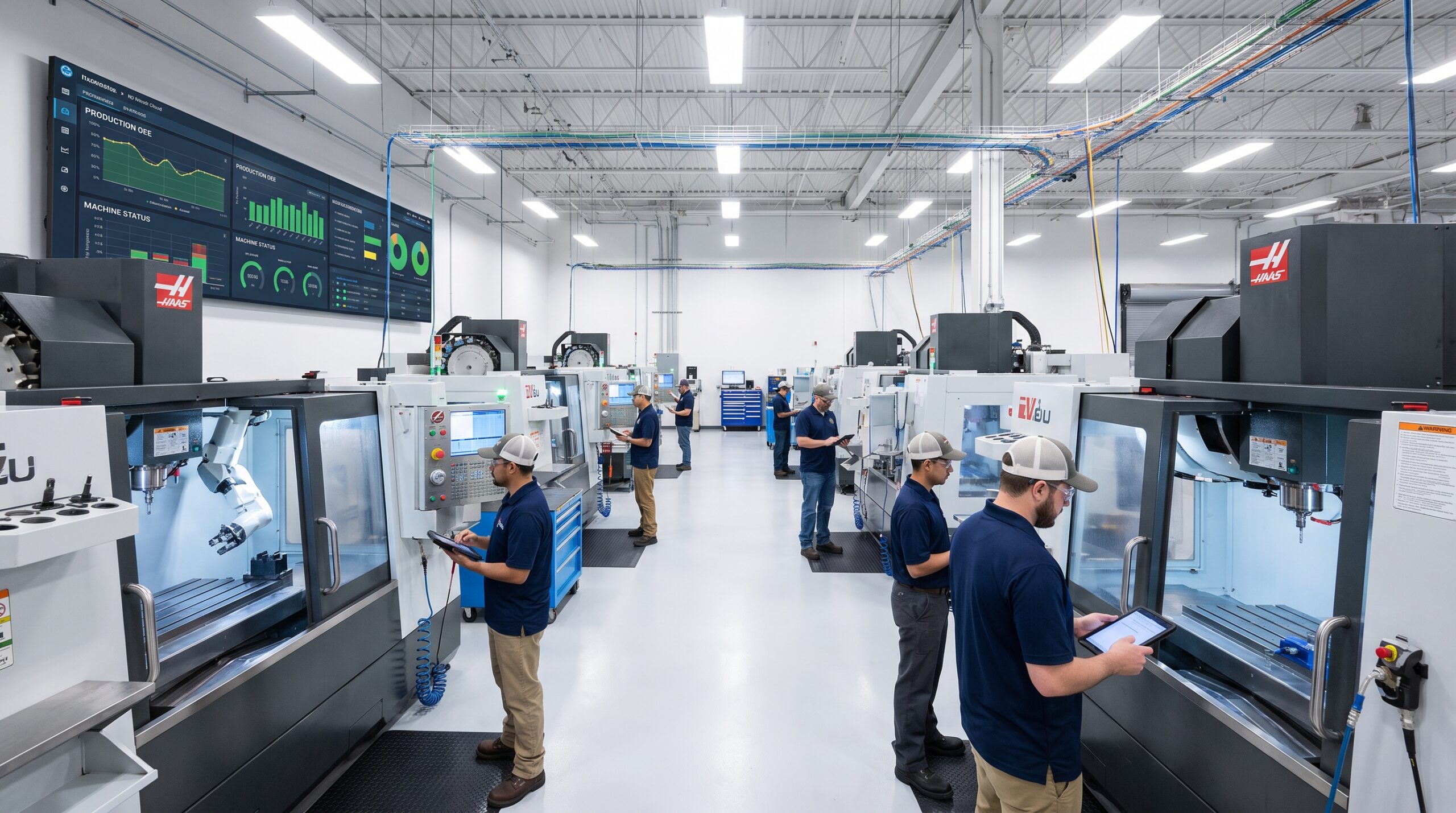
Automated data collection through PLCs, sensors, and barcode scanning removes most of the human error in reporting. When operators only need to confirm or categorize data rather than enter it, accuracy jumps. Real-time dashboards on the floor turn that data into a daily management tool rather than a monthly report.
Process Control and Automation
Control comes after measurement. Once a process is measured accurately, the next step is to reduce variation. That might mean tighter machine setups, better fixturing, more consistent raw material, or automated adjustments based on sensor feedback. The right answer depends on where the variation actually originates, which is why measurement comes first.
Warehouse and material flow contribute to process variation in ways that are easy to miss. A part that sits too long in staging may absorb humidity. A bin that gets picked from the wrong location introduces the wrong revision into assembly. Integrating production with warehouse control system automation reduces these material-driven defects.
Performance Metrics That Actually Drive Behavior
Metrics matter because what gets measured gets managed. The wrong metrics drive the wrong behavior. A plant measured only on throughput may push marginal product out the door. A plant measured only on quality may slow down too much. Balanced scorecards that combine throughput, quality, cost, safety, and delivery push teams toward overall performance.
Common metrics worth tracking include:
- First pass yield: percentage of units that pass all checks the first time without rework
- Overall equipment effectiveness (OEE): combination of availability, performance, and quality
- Cost of poor quality: total dollars spent on prevention, appraisal, and failure
- On-time delivery: percentage of orders shipped complete and on date
- Customer complaint rate: complaints per million units shipped
- Mean time between failures: reliability indicator for both equipment and product
Metrics should be visible to the people who can influence them. A dashboard in the executive office that operators never see does little to change daily behavior. The same dashboard on the floor, updated hourly, becomes a coaching tool.
Future Trends and Technologies in Manufacturing Quality Improvement
The next decade of quality improvement will look different from the last one. Several technologies that were experimental five years ago are now production-ready, and a few more are on the near horizon. Comparing them helps in deciding where to invest first.
Emerging Technologies Worth Watching
Industrial IoT continues to expand. Low-cost sensors monitor vibration, temperature, humidity, and energy use across more equipment than ever before. The data feeds predictive maintenance models that prevent failures rather than respond to them. For quality, the same data identifies process drift before it produces defects.
Digital twins simulate physical processes in software. Engineers test changes virtually before implementing them, which shortens improvement cycles and reduces risk. A digital twin of a packaging line can reveal that a proposed speed increase would cause label misalignment, saving the cost of a failed trial.
Augmented reality is finding traction in assembly and inspection. Operators wearing AR glasses see work instructions overlaid on the part, with red flags appearing if a step is missed or out of sequence. Training time drops, and error rates fall, particularly for complex or low-volume products.
Blockchain-based traceability is emerging in industries where provenance matters, such as food, pharmaceuticals, and luxury goods. Every step of production and distribution writes to a shared ledger that customers can verify. The technology is still maturing, but the use cases are becoming clearer.
For broader perspectives on these trends, publications like Quality Magazine and Manufacturing.net regularly cover real-world implementations and emerging tools.
Comparing Investment Paths
Not every plant should chase every technology. A useful comparison frames the options by payback timeframe and required maturity:
- Short payback, low maturity required: automated data collection, real-time dashboards, basic SPC software
- Medium payback, moderate maturity required: machine vision inspection, predictive maintenance, MES integration
- Longer payback, high maturity required: AI-driven process optimization, digital twins, full traceability platforms
A plant just starting its quality journey should not skip the first category to chase the third. Foundational data quality and basic visibility are prerequisites for anything more advanced. Investments in AI without clean data produce expensive disappointment.
Patterns from Successful Implementations
Across industries, the plants that improve quality most successfully share a few patterns. They invest in people before, during, and after technology rollouts. They start with a clearly defined problem rather than a technology in search of a use. They measure baseline performance before changes so they can prove the impact afterward. And they treat improvement as a continuous program, not a project with a finish line.
Consider a hypothetical mid-sized contract manufacturer that handled both discrete and process manufacturing operations. Faced with rising warranty claims, leadership did not jump to AI inspection. Instead, the team mapped the warranty data by product family, identified that two assembly stations accounted for most defects, and added simple poka-yoke fixtures that made the wrong assembly physically impossible. Defects dropped before any new technology was purchased. The team then layered in vision inspection at the highest-volume station, capturing the remaining variation. The combination of low-tech and high-tech changes delivered better results than either alone.
The same pattern repeats across wholesale distribution operations and third-party logistics providers. Process discipline plus targeted technology beats either approach alone.
Building Your Quality Improvement Roadmap
Pulling these comparisons together into an actionable roadmap takes some honest self-assessment. Where is your operation today on data, on process discipline, on workforce engagement, and on technology? The answer points to the next logical step rather than the most exciting one.
A typical roadmap follows four phases. First, stabilize: get the basics right, including documented procedures, accurate data collection, and consistent training. Second, control: reduce variation with SPC, error-proofing, and supplier development. Third, improve: launch targeted projects using Lean, Six Sigma, or Kaizen to address the largest cost-of-quality drivers. Fourth, innovate: deploy AI, digital twins, or other advanced tools where the foundation supports them.
Most plants are somewhere in phases two or three. Skipping phases rarely works. A plant that tries to install AI inspection while still using paper checklists and inconsistent training will struggle to capture value from the investment. Sequencing matters as much as selection.
Conclusion
Improving product quality in manufacturing is less about choosing the right framework and more about combining proven methods with modern tools in the right sequence for your operation. Traditional programs like ISO 9001 and Six Sigma still deliver results, technology investments amplify those results when the foundation is solid, and engaged people remain the factor that ties everything together. The comparisons in this guide are starting points, not prescriptions; the right path depends on your products, your customers, and the maturity of your current systems.
If you are ready to take the next step, here are three ways to move forward:
- Explore ASC Software solutions for quality and operations management to see how integrated platforms support better decision making
- Contact our team for a consultation to discuss your specific quality improvement priorities
- Schedule a demo of our manufacturing and warehouse platforms to see real-world quality and traceability features in action
Quality improvement is a long game, but every plant that commits to it sees compounding returns. The sooner the next step starts, the sooner those returns begin.
Frequently Asked Questions
How can you improve quality in manufacturing?
Improving quality in manufacturing involves implementing robust quality management systems and leveraging technology. This includes adopting real-time analytics, enhancing workforce training, and integrating automated inspection tools. By focusing on both process and product improvement, manufacturers can achieve greater consistency and reduce defects. Combining traditional quality programs with modern technology can offer a balanced approach tailored to specific operational needs.
What is the importance of quality control in manufacturing?
Quality control in manufacturing is crucial for reducing defects and maintaining customer satisfaction. Effective quality control prevents costly recalls and protects the company’s reputation. It involves systematic checks and balances throughout the production process to ensure products meet specifications. By prioritizing quality control, manufacturers can minimize waste, improve efficiency, and enhance overall product reliability, leading to increased customer loyalty and reduced operational costs.
How does quality management in manufacturing industry work?
Quality management in the manufacturing industry involves a systematic approach to ensuring product quality and process efficiency. It integrates various strategies like Six Sigma, statistical process control, and continuous improvement models. These methods help in identifying defects early and maintaining consistency across production. By fostering a culture of quality and utilizing advanced technologies, manufacturers can achieve higher standards and meet regulatory requirements effectively.
What are effective product improvement ideas for manufacturing?
Effective product improvement ideas include adopting lean manufacturing principles and incorporating customer feedback into design processes. Manufacturers can also invest in automation and AI-driven inspection systems to enhance precision. Regularly reviewing and updating production techniques based on data analytics can lead to significant quality improvements. By continuously innovating and adapting to market demands, companies can maintain a competitive edge and improve their product offerings.
How to improve manufacturing process for better efficiency?
Improving the manufacturing process involves streamlining operations and embracing technology for efficiency gains. Implementing lean practices reduces waste and enhances workflow. Automation and real-time monitoring tools help in identifying bottlenecks and optimizing production schedules. By investing in employee training and fostering a culture of continuous improvement, manufacturers can achieve higher productivity and lower operational costs while maintaining product quality.