





5 Reasons to Invest in Your WMS Software
Kurt AdamsPublished: March 1, 2022 | Updated: February 17, 20266 minutes
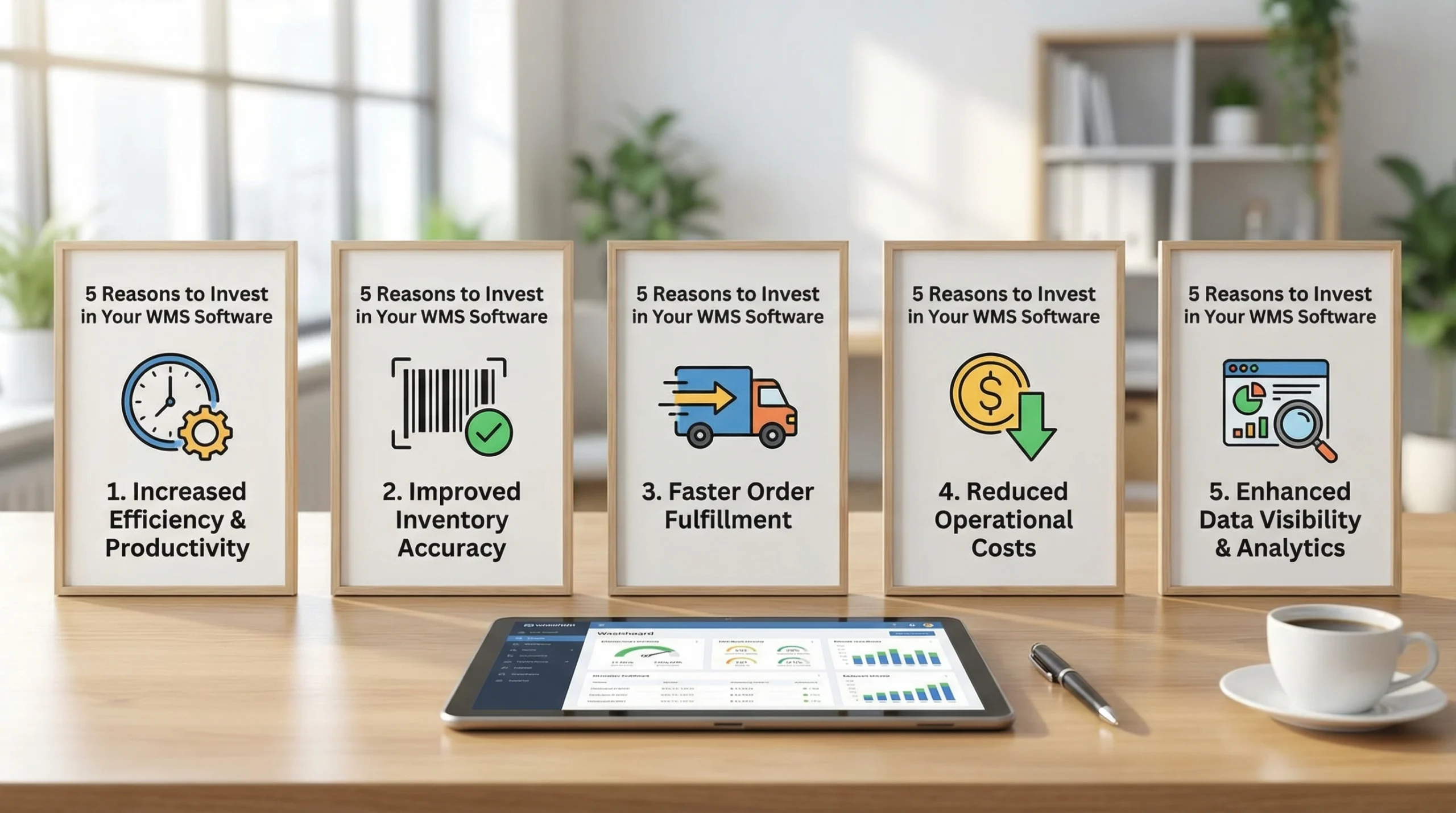
Check out this list of key reasons you should take a second look at your current ERP and warehouse management system (WMS) software.
Times have been hard for many businesses, including warehouses and manufacturers. If you’re struggling to keep up with the growth of e-commerce orders while using outdated software and hardware, it’s time to invest in your business. Here are five reasons to keep your WMS operations up to date by updating and integrating the latest digital functions into your system.
1. Self-Service Savings
If you haven’t provided online access to inventory and ordering for your sales force and customer base, you are behind the times. Instead of stock check calls, manual order entry, and paper proofs of delivery, it could all be done electronically, via self-service web access. This would drastically improve efficiency, increase customer service levels, and save your staff loads of time. The end result gives you an additional advantage over competitors that do not offer these services.
Smarter Warehouse Management Starts Here
ASCTrac WMS delivers real-time visibility, automated workflows, and seamless ERP integration for warehouses of every size.
Request a Demo
2. Increase Online Sales
E-commerce was something most end-customers just dabbled in prior to the COVID-19 pandemic. With storefronts forced to shutter during much of the past two years, online ordering became and, in some cases, continues to be the only option for companies to place products directly into consumers’ hands. Is your WMS system set up to break open cartons and process e-commerce orders? Is it running efficiently? If not, you needed to upgrade yesterday. Don’t fret, ASC’s digital solutions can help you set up a state-of-the-art e-commerce back-end system to handle “one-each” sales orders with shopping cart integrations that bring your company easily into the mainstream.
3. Avoid Operational Issues and Increase System Security
Your current WMS software has worked for your warehouse or manufacturing facility so far. Are you experiencing little glitches? Is your WMS system constantly crashing? Is your firewall secure? Nothing is worse than not being able to conduct or complete daily customer orders due to IT system errors or, worse yet, ransomware demands. If your software or hardware cannot keep up with today’s demands, you should most definitely have your IT infrastructure evaluated for speed, security, and best practices.
4. Operate at Maximum Efficiency
It is important that your software provider be constantly monitoring your current ERP and/or WMS software system and identifying areas for improvement. A stagnant system cannot keep up with the ever-changing economic climate and business demands. Your software provider should be interacting with your company regularly to identify areas of improvement and upgraded functionality. These might be provided via add-on modules or in regularly scheduled software updates. For example, ASC is on version 10.02 of ASCTrac®with version 11 due out in Q2. Ensure that your warehouse or manufacturing facility is running at maximum efficiency by keeping your software up to date.
5. It Costs Less in the Long Run
Money is tight for everyone, and capital is closely guarded. However, if you are holding off on needed WMS software upgrades, it could affect your bottom line directly. Regular software upgrades are essential to maintaining working systems properly and saving valuable employee time while providing the best service to your customers. Newer feature add-ons in both software and hardware will pay off quickly. Consider adding ASCTrac® Mobile Device Manager or Voice Picking options to enhance your company’s efficiency.
As a Top 100 IT Solutions Provider, you can rely on next-generation software and hardware solutions from ASC. Learn more about ASC’s premium solutions for warehouses and manufacturers.
Ensure Regulatory Compliance and Audit Readiness
Modern WMS software provides the documentation and traceability capabilities essential for meeting industry regulations and passing audits. As regulatory requirements become more stringent across industries—from FDA compliance in pharmaceuticals to ISO standards in manufacturing—your warehouse operations must maintain detailed records of inventory movements, temperature controls, and handling procedures.
An updated WMS automatically captures and stores critical compliance data, including:
-
Lot tracking and serialization for complete product traceability from receipt to shipment
-
Temperature and environmental monitoring with automated alerts for deviations
-
Chain of custody documentation showing who handled products and when
-
Expiration date management with FEFO (First Expired, First Out) picking strategies
-
Recall management capabilities to quickly identify and isolate affected inventory
Legacy systems often lack these automated compliance features, forcing warehouse staff to maintain manual records that are time-consuming, error-prone, and difficult to retrieve during audits. When regulatory inspectors arrive, having instant access to comprehensive digital records can mean the difference between a smooth audit and costly violations that could shut down operations.
Scale Operations to Meet Fluctuating Demand
Business growth and seasonal demand fluctuations require warehouse systems that can scale efficiently without breaking down or requiring complete overhauls. Older WMS platforms often hit performance walls when transaction volumes increase, leading to slower processing times, system crashes, and inability to handle peak periods effectively.
Modern WMS investments support scalability through:
-
Cloud-based architecture that automatically adjusts computing resources based on demand
-
Multi-location management from a single system as your business expands geographically
-
Flexible user licensing that allows you to add temporary workers during peak seasons without major cost increases
-
Advanced wave planning to optimize picking routes and labor allocation during high-volume periods
Consider a retailer preparing for Black Friday: an outdated WMS might struggle to process the 300% increase in daily orders, causing delays and frustrated customers. A properly scaled modern system handles these spikes seamlessly while maintaining accuracy and speed.
Plan for Future Technology Integration
Investing in current WMS technology positions your warehouse for future automation and advanced technologies. Today’s systems are designed with APIs and integration capabilities that support emerging technologies like robotics, artificial intelligence, and IoT sensors. This forward-thinking approach prevents technology silos and ensures your warehouse can adopt new innovations without complete system replacements.
Future-ready WMS platforms support integration with autonomous mobile robots (AMRs), voice picking systems, and predictive analytics tools that can further optimize warehouse operations as your business grows and technology advances.
Frequently Asked Questions
What is a warehouse management system and what does it do?
A warehouse management system is software that controls and optimizes daily warehouse operations including receiving, putaway, inventory tracking, picking, packing, and shipping. WMS provides real-time visibility into inventory levels and locations, directs worker tasks, and ensures accuracy through barcode scanning. Modern WMS solutions integrate with ERP and ecommerce platforms for seamless order fulfillment.
How does WMS software improve inventory accuracy?
WMS improves accuracy by requiring barcode scans at every transaction point, eliminating manual data entry errors. The system tracks inventory in real-time, showing exactly what products are in which locations. Cycle counting features identify discrepancies quickly. This accuracy reduces stockouts, prevents overstocking, and improves customer satisfaction through reliable order fulfillment.
What cost savings can companies expect from implementing WMS?
Companies typically see labor cost reductions of 15-30 percent through optimized picking paths and task management. Inventory carrying costs decrease as accuracy improves and safety stock requirements drop. Shipping errors and returns decline, reducing associated costs. Space utilization improvements may defer or eliminate warehouse expansion needs. Most WMS implementations achieve positive ROI within 12-18 months.
When is the right time to upgrade or replace WMS software?
Consider upgrading when your current system cannot support business growth, lacks integration capabilities with modern platforms, or requires excessive manual workarounds. Signs include increasing order errors, inability to meet customer delivery expectations, or reliance on spreadsheets outside the WMS. Legacy systems that lack vendor support or cloud capabilities also warrant replacement evaluation.
How do I calculate ROI for a warehouse management system investment?
Calculate WMS ROI by measuring labor cost reductions, inventory accuracy improvements, space utilization gains, and error reduction. Track metrics like picks per hour, order accuracy rates, and inventory carrying costs before and after implementation. Most WMS solutions deliver 15-30 percent labor savings and 25-50 percent reduction in shipping errors, typically achieving positive ROI within 12-18 months.