




Economic Order Quantity (EOQ): Definition and Formula
Kurt AdamsPublished: August 9, 2023 | Updated: February 17, 20267 minutes

In the complex landscape of warehouse management, one concept that stands as a cornerstone across various industries is the Economic Order Quantity (EOQ). The EOQ model is a calculation that companies use to determine the optimal order quantity that minimizes total inventory costs. These costs include holding costs, order costs, and shortage costs. By accurately calculating EOQ, businesses can strike a balance between holding too much inventory, which increases holding costs, and ordering too frequently, which increases order costs.
Unpacking Economic Order Quantity (EOQ)
EOQ is a measure that helps businesses maintain optimal inventory levels. It’s a formula that considers annual demand, consumer demand, and holding costs per unit to calculate the most cost-effective quantity to order. This balance ensures that the right amount of inventory is available when needed, minimizing total costs and enhancing overall operational efficiency.
Smarter Warehouse Management Starts Here
ASCTrac WMS delivers real-time visibility, automated workflows, and seamless ERP integration for warehouses of every size.
Request a Demo
The Advantages of Calculating EOQ
Calculating EOQ offers several advantages that can significantly enhance warehouse operations across industries:
-
It helps minimize total inventory costs by determining the most cost-effective order quantity.
-
It aids in avoiding stockouts and overstocks, ensuring that the right amount of inventory is available when needed.
-
It contributes to overall operational efficiency by streamlining the ordering process and reducing unnecessary expenditures.
The Mechanics of EOQ: Key Factors and Formula
The EOQ formula revolves around three key variables: holding costs, demand, and order cost.
Holding costs refer to the costs associated with storing inventory, including warehousing, insurance, and depreciation costs. Demand is the number of units that customers are expected to purchase in a given period, often measured in units per year. Order cost is the cost incurred every time an order is placed, including shipping and handling costs.
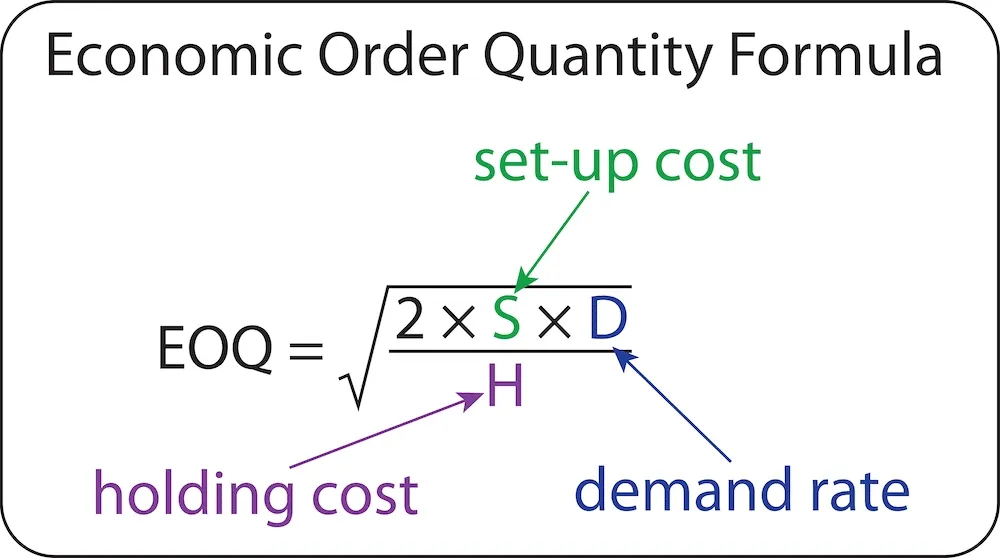
The EOQ formula, also known as the order quantity formula, is as follows:
EOQ = square root of: [2SD] / H
Where:
S = Setup costs (Order Cost)
D = Demand rate (Annual Demand)
H = Holding costs per unit
This formula provides a quantitative basis for determining the optimal order quantity that minimizes total inventory costs, including annual holding cost, cost per order, and fixed costs.
EOQ in Action: Applications Across Industries
EOQ is a versatile tool that finds application across a wide range of industries.
In wholesale and distribution, EOQ can help manage large volumes of inventory, ensuring that products are always available for distribution without tying up too much capital in stock.
In manufacturing, including 3PL manufacturing, EOQ can aid in managing raw materials and finished goods inventory, aligning production schedules with demand patterns.
In the food and beverage and pharmaceutical industries, where products often have short shelf lives, EOQ can help minimize waste and ensure product availability.
In 3PL logistics and catalog fulfillment, EOQ can optimize the storage and movement of goods, enhancing service levels and customer satisfaction.
In the consumer goods, automotive, and aerospace industries, EOQ can help manage complex supply chains, ensuring that parts and products are available when needed, without overstocking.
Beyond EOQ: Additional Strategies for Inventory Optimization
While EOQ is a powerful tool, it’s not the only strategy for inventory optimization. Other strategies include setting reorder points to determine when to place a new order, maintaining safety stock to buffer against demand variability, and tracking inventory in real-time to make informed decisions.

The Role of Technology in EOQ Calculation and Inventory Management
In today’s modern age, technology plays a significant role in EOQ calculation and inventory management. A robust Warehouse Management System (WMS) like ASC Software’s ASCTrac® can automate the EOQ calculation, provide real-time inventory data, and streamline operations. This allows managers to focus more on strategic tasks such as inventory planning, sales forecasting, and process improvement.
ASCTrac® offers features like real-time inventory tracking, automated replenishment, and detailed reporting. These features can significantly enhance your ability to manage your EOQ effectively, leading to improved operational efficiency and profitability.
Common EOQ Implementation Challenges and Solutions
While the economic order quantity model provides a solid foundation for inventory optimization, warehouse managers often encounter practical challenges when implementing EOQ calculations in real-world operations. Understanding these obstacles and their solutions is crucial for maximizing the advantages of EOQ in your supply chain strategy.
Data Accuracy and Demand Forecasting Issues
One of the most significant challenges involves obtaining accurate demand data. Many warehouses struggle with inconsistent historical data or seasonal fluctuations that make traditional EOQ calculations less reliable. EOQ software solutions can help address this by integrating real-time data from multiple sources and applying advanced forecasting algorithms that account for demand variability.
Key strategies for overcoming data challenges include:
-
Implementing automated data collection systems to reduce manual entry errors
-
Using rolling averages to smooth out demand fluctuations
-
Regularly reviewing and updating demand parameters based on market trends
-
Incorporating safety stock calculations alongside EOQ to buffer against uncertainty
Supplier Constraints and Lead Time Variability
The traditional economic order quantity formula assumes consistent lead times and unlimited supplier capacity, which rarely reflects reality. Suppliers may have minimum order requirements, quantity discounts, or variable delivery schedules that conflict with optimal EOQ calculations. Successful implementation requires adapting the EOQ model to accommodate these real-world constraints while still capturing the core benefits of cost optimization.
EOQ Integration with Modern Warehouse Management Systems
The integration of economic order quantity calculations with warehouse management systems (WMS) represents a significant advancement in inventory optimization. Modern technology enables automated EOQ calculations that continuously adjust based on real-time inventory levels, demand patterns, and cost fluctuations.
Automated Reorder Point Calculations
Advanced WMS platforms now incorporate EOQ algorithms that automatically trigger purchase orders when inventory reaches predetermined reorder points. This automation eliminates manual calculation errors and ensures consistent application of what is economic order quantity principles across all SKUs. The system continuously monitors holding costs, order costs, and demand rates to provide dynamic EOQ recommendations.
Multi-Location EOQ Optimization
For warehouses operating across multiple locations, modern systems can calculate location-specific EOQ values while considering transfer costs between facilities. This approach is particularly valuable in industries like railway logistics, where understanding EOQ full form in railway operations means optimizing inventory across extensive distribution networks. The system factors in transportation costs, regional demand variations, and facility-specific holding costs to determine optimal order quantities for each location.
Key features of integrated EOQ systems include:
-
Real-time cost tracking and automatic parameter updates
-
Scenario modeling for different demand and cost conditions
-
Integration with supplier portals for streamlined ordering processes
-
Performance analytics to measure EOQ effectiveness over time
Conclusion
Mastering the Economic Order Quantity (EOQ) is a crucial aspect of effective warehouse management across industries. It provides valuable insights into your inventory’s performance, helps optimize operations, and impacts your bottom line. By understanding this key performance indicator, implementing strategic measures, and leveraging technology like our ASCTrac® software, you can significantly enhance your warehouse operations.
Take the first step towards mastering your EOQ. Explore how our ASCTrac® software can transform your warehouse operations and help you manage your inventory more effectively. Contact us today to learn more or schedule a demo. Our team of experts is ready to help you optimize your EOQ and achieve your warehouse management goals.
Frequently Asked Questions
What is Economic Order Quantity?
Economic Order Quantity is a formula that calculates the optimal order size minimizing total inventory costs. It balances ordering costs incurred with each replenishment against carrying costs of holding inventory. EOQ helps determine how much to order to minimize the combined expense of obtaining and storing inventory.
How do you calculate EOQ?
The EOQ formula is the square root of (2 times annual demand times ordering cost per order divided by annual carrying cost per unit). Inputs include annual demand quantity, fixed cost per order for ordering and receiving, and annual holding cost per unit typically expressed as percentage of unit value times unit cost.
What assumptions does EOQ rely on?
EOQ assumes constant and known demand rate, fixed ordering cost independent of quantity, constant unit price without quantity discounts, and instantaneous replenishment without stockouts. Real situations rarely match all assumptions exactly, but EOQ still provides useful guidance that can be adjusted for practical constraints.
When should warehouses use EOQ calculations?
EOQ works best for stable-demand items with consistent costs and reasonable forecast accuracy. It provides a starting point for ordering decisions that can be adjusted for quantity discounts, supplier constraints, or storage limitations. Items with highly variable demand or significant price fluctuations may need more sophisticated approaches.
What are the limitations of EOQ?
Limitations include assumptions that rarely hold exactly in practice, inability to handle demand variability directly, exclusion of quantity discounts and supplier constraints, and focus on individual items rather than coordinated ordering. EOQ provides useful guidance but should be applied with understanding of its constraints and adjusted for practical considerations.