




Medical Device Serialization vs. DSCSA: A Warehouse Guide
Kurt AdamsPublished: November 19, 202614 minutes

What Is Medical Device Serialization?
Medical device serialization means giving each device, or each lot of devices, a unique machine-readable identifier on its label and packaging. Regulators call this the Unique Device Identification (UDI) system. Each UDI appears in plain text and in an automatic identification and data capture (AIDC) format, usually a linear barcode or a 2D DataMatrix.
UDI was built for patient safety, adverse event reporting and precise recalls. It was not designed for unit-level track-and-trace between trading partners. Manufacturers submit identifying data to a regulatory database, but nothing resembles the transaction-by-transaction exchange that DSCSA requires for drugs. That gap explains why the two programs feel so different on the warehouse floor.
Consider a distributor that stocks both orthopedic implants and boxes of exam gloves. The implants arrive with serial numbers that must follow each unit to the hospital, while the gloves carry only a lot code. Both products fall within UDI, yet they call for very different handling once they reach receiving.
How do the device identifier and production identifier differ?
- UDI-DI: A static code naming the labeler and the specific model or version. Under GS1 standards, it is a Global Trade Item Number (GTIN).
- UDI-PI: Variable data for one unit: serial number, lot or batch, expiration date, manufacture date, or a distinct identification code for certain human cell and tissue products.
The DI says what the device is. The PI says which one you are holding. Recalls and traceability depend on capturing both.
Who issues UDIs, and where is the data stored?
The FDA accredits three issuing agencies, and the EU designates the same three: GS1 (GTIN-based and the most common), HIBCC (frequent in surgical and hospital supplies) and ICCBBA (ISBT 128 for blood, tissue and cellular products).
DI-level attributes go to the FDA's Global Unique Device Identification Database (GUDID) for US devices and to EUDAMED for the European market. Neither database stores individual serial numbers. PI data lives on the label and in manufacturer and distributor systems.
When are serial numbers required instead of lot control?
UDI does not always mean unit-level serials. Under 21 CFR Part 801, Subpart B, the PI must include whichever of lot, serial, expiration or manufacture date already appears on the label. Capital equipment and high-risk devices are often serialized, and the EU MDR mandates serial numbers for active implantables. Many single-use disposables carry a lot number only, while some labels show both. Your WMS should set the control mode per item, not per facility.
What are the FDA UDI and EU MDR compliance timelines?
FDA UDI rule (final rule September 2013):
- Class III: September 24, 2014
- Implantable, life-supporting and life-sustaining: September 24, 2015
- Class II: September 24, 2016
- Class I and unclassified: September 24, 2018, with an enforcement policy extending certain requirements to September 24, 2022
EU MDR labeling:
- Class III and implantable: May 26, 2021
- Class IIa and IIb: May 26, 2023
- Class I: May 26, 2025
- Direct marking of reusable devices: two years after each class's labeling date
EUDAMED modules are phasing in under Regulation (EU) 2024/1860, so confirm current mandatory-use dates on the European Commission's EUDAMED page.

Purpose-Built for Pharmaceutical Compliance
ASCTrac helps pharmaceutical operations stay GMP-compliant with lot tracking, serialization, and DSCSA-ready workflows.
Request a Demo
What Is Serialization in Pharmaceutical Packaging?
A common search, "what is serialization pharmaceutical packaging," has a short answer: every saleable unit of a prescription drug gets a unique serial number, encoded alongside other product data in a 2D barcode, so it can be identified and verified at each handoff.
Device UDI centers on identification and recalls. Pharmaceutical serialization, by contrast, is built for interoperable tracing between trading partners and authentication at defined checkpoints. Codes are printed and checked on the packaging line, but the data also has to reach enterprise systems, customers and, in some countries, government repositories.
What are the four DSCSA product identifier elements?
US requirements, set out in the Drug Supply Chain Security Act, call for a product identifier on each package and homogeneous case:
- National Drug Code (NDC): usually embedded in a GS1 GTIN.
- Serial number: up to 20 alphanumeric characters, unique per NDC.
- Lot number.
- Expiration date.
The NDC plus serial number forms the standardized numerical identifier (sNDC). Packages carry this data in a 2D DataMatrix with human-readable text. Homogeneous cases may use a linear or 2D barcode.
How do 2D DataMatrix encoding and print quality work?
GS1 AIs structure the data: (01) GTIN, (21) serial, (10) lot and (17) expiration. Print quality is graded under ISO/IEC 15415 and the GS1 DataMatrix Guideline.
- Vision systems check every code for readability and correct content.
- Many trading partners expect grade C or better.
- Weak prints cause scan failures later at receiving and returns, so line verification is where warehouse readiness starts.
What is aggregation, and why does it matter?
Aggregation records the parent-child links between units, cases and pallets, so one pallet scan can stand in for hundreds of unit serials. The DSCSA does not explicitly mandate it, yet most US companies depend on it to exchange data efficiently. Markets such as Russia and Saudi Arabia require aggregation reporting outright. Accurate hierarchies are what make serialized receiving workable at volume, and they connect directly to everyday warehouse inventory management practices like cycle counts and lot control.
What are Levels 1-5 of serialization architecture?
The industry usually describes these systems in five layers:
- Level 1: printers, cameras and scanners.
- Level 2: line controllers for printing, inspection and aggregation.
- Level 3: site servers managing serial numbers and batches across lines.
- Level 4: enterprise serialization and ERP systems.
- Level 5: network exchange with customers, suppliers and regulators.
A WMS works alongside Levels 4 and 5, consuming and producing serialized events.

Drug Serialization Requirements in 2025 and Beyond: DSCSA and Global Mandates
Drug serialization has moved well past printing codes on cartons. The focus now is enhanced drug distribution security: exchanging serialized transaction data electronically, verifying product at the package level, and answering suspect product investigations and recalls quickly. For US trading partners, that work falls under DSCSA section 582(g). Elsewhere, identifiers, aggregation rules and reporting models differ widely. Cross-border shippers often run several compliance models side by side, sometimes next to device UDI programs in the same building.
What changed when the DSCSA stabilization period ended?
The enhanced security requirements took effect November 27, 2023. A one-year FDA stabilization period followed and closed November 27, 2024. In October 2024, the agency granted targeted exemptions so partners still finishing data connections could keep product moving. These exemptions are temporary and phased by role, so your real deadline depends on where you sit in the supply chain.
Which DSCSA exemption dates apply to your organization?
Based on FDA announcements:
- Manufacturers and repackagers: May 27, 2025
- Wholesale distributors: August 27, 2025
- Dispensers with 26 or more full-time employees: November 27, 2025
- Small dispensers (25 or fewer FTEs): November 27, 2026
Some companies also hold individual waivers. Confirm your status through the FDA's DSCSA resources and with your partners.
How do EPCIS and VRS fit into DSCSA compliance?
- EPCIS (Electronic Product Code Information Services): The GS1 standard most US partners use to exchange transaction information and statements. Every shipment produces events that must match the physical goods.
- VRS (Verification Router Service): A network that routes product identifier checks to the manufacturer. Distributors rely on it to confirm saleable returns before resale.
Interoperability means EPCIS data, dock scans and partner records all agree. A pharma warehouse management system ties each scan to the data you send.
How do global drug serialization requirements compare?
Each market below differs in what it encodes, whether it demands aggregation and how data reaches regulators:
- United States (DSCSA): The identifier combines GTIN/NDC with serial, lot and expiry. Aggregation is not mandated but is widely used. Partners exchange data via EPCIS, and VRS handles returns checks.
- European Union (FMD): Packs carry a product code, serial, batch and expiry, plus a national reimbursement number where a country requires one. There is no aggregation requirement. Manufacturers upload data to the European Medicines Verification System, and packs are decommissioned at dispense.
- China: Products use an NMPA drug traceability code. Aggregation is commonly expected, and reporting runs through government and enterprise traceability platforms.
- Russia (Chestny ZNAK): Codes hold a GTIN, a serial and a crypto code. Aggregation is required, and the government receives full track-and-trace reporting.
- India: Exports use GS1 codes, while designated domestic brands carry QR codes. Exporters must aggregate and report through iVEDA.
- Brazil: ANVISA defined a unique identifier under SNCM. Aggregation is planned, and the centralized system is still evolving.
- Saudi Arabia (RSD): Codes hold a GTIN, serial number, batch number and expiration date. Aggregation is mandatory, and data goes to the SFDA Drug Track and Trace System.
The EU FMD also mandates an anti-tampering device. Rules shift often, so check with each regulator before shipping.
How Does Medical Device Serialization Compare With Drug Serialization?
Both regimes rely on GS1 barcodes, GTINs and production data, so they are easy to mix up. The difference is purpose. UDI identifies a device so it can be traced in adverse event reports and recalls. Drug serialization supports transaction-level traceability and package authentication as product changes hands.
Device vs. drug serialization comparison table
The factors below set the two regimes side by side, with devices listed first and drugs second:
- Regulatory basis. Devices: FDA UDI rule, EU MDR and IVDR. Drugs: DSCSA, EU Delegated Regulation 2016/161.
- What gets serialized. Devices: the label and device packages, with serial or lot control set by device type. Drugs: every saleable package, plus homogeneous cases in the US.
- Identifiers. Devices: UDI-DI plus UDI-PI. Drugs: GTIN/NDC, serial number, lot and expiration.
- Data carriers. Devices: linear, 2D or RFID, always with human-readable text. Drugs: 2D DataMatrix on packages.
- Databases. Devices: GUDID and EUDAMED, holding DI-level attributes only. Drugs: EPCIS exchange, VRS and EU repositories, all working with unit-level data.
- Aggregation. Devices: not required. Drugs: not mandated in the US or EU, though some other markets demand it.
- Verification duties. Devices: no routine unit verification. Drugs: verify suspect product and saleable returns.
- Current deadlines. Devices: FDA phases are complete, and EU Class I labeling arrived May 26, 2025. Drugs: DSCSA exemptions expire in stages through 2025 and 2026.
How are combination products handled?
Prefilled syringes, drug-eluting stents and similar combination products can land under either regime. Under US rules, a combination product whose label bears an NDC is generally handled under drug labeling rules, although its device constituent parts may still need their own UDI. Classification decisions belong with your regulatory team, guided by the FDA's combination product guidance, not with the warehouse floor.
What does this mean for companies that handle both?
Distributors and 3PLs carrying mixed inventory need rules set at the item level, not across the whole facility:
- Flag each SKU as serial-controlled, lot-controlled or DSCSA-serialized.
- Parse GS1 Application Identifiers and HIBCC formats from the same scanner.
- Send drug transaction data to EPCIS while keeping a full serial and lot history for devices.
- Apply returns verification only to products covered by DSCSA.
Physical layout matters too. Placing serialized drugs and devices in separate zones as part of your warehouse slotting plan cuts down on mixed picks and scanning errors.
How Does Serialization Change Warehouse Operations?
Regulations are written for trading partners, but people with scanners carry them out. Whether the driver is DSCSA or UDI, each requirement becomes a floor task, and the goal is constant agreement among physical product, system records and partner data.
Receiving and aggregation verification
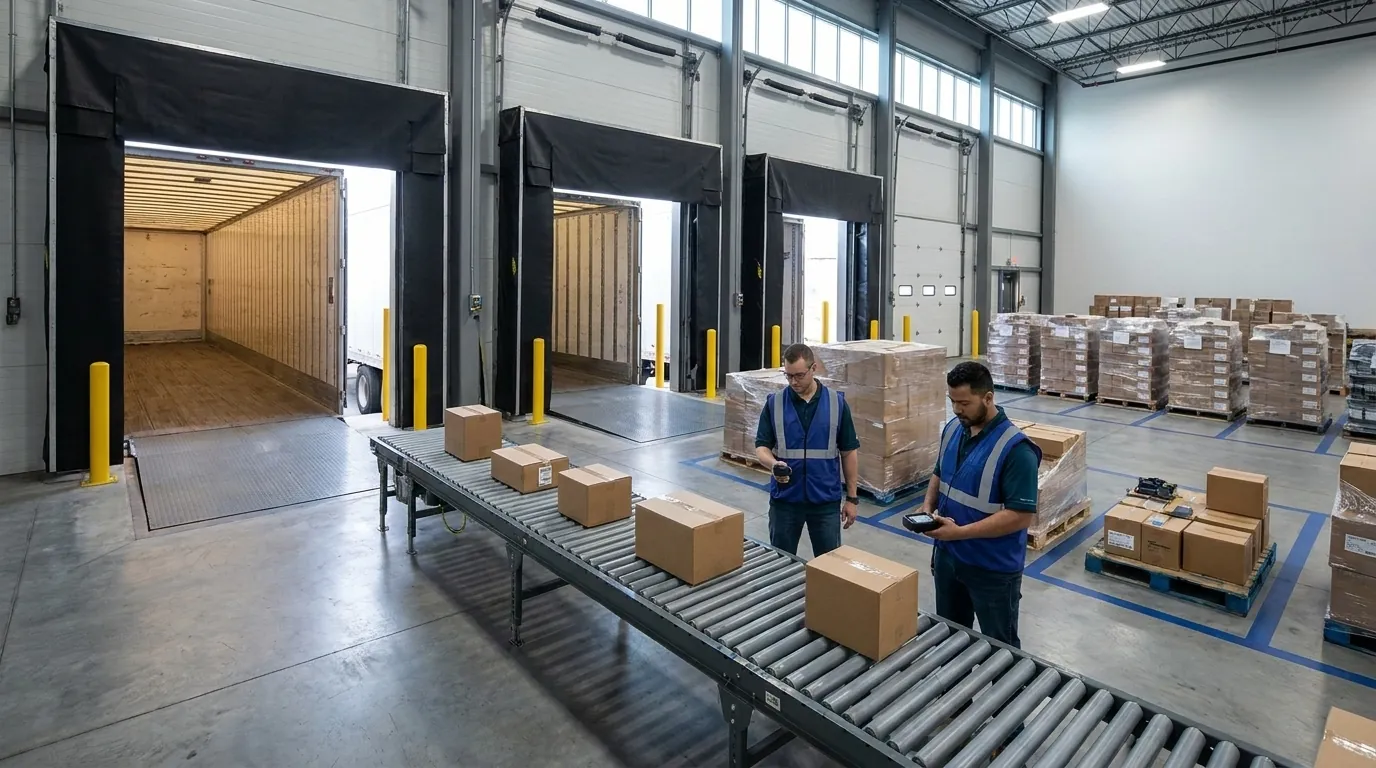
- Scan the pallet or case SSCC and match it against inbound EPCIS data before putaway.
- Spot-check unit serials inside cases to confirm aggregation.
- For devices, capture lot, serial and expiry from the UDI-PI at the dock.
- Stage any receipt with missing or mismatched data. Our warehouse receiving guide covers these dock workflows in more depth.
Handling aggregation errors
Typical errors include missing children, extra units and reworked cases whose data was never updated. Route discrepancies to an exception queue instead of fixing them quietly. Re-aggregate only with a documented reason code, and alert the upstream partner so both sets of records match.
Consider a hypothetical inbound case whose EPCIS data lists 24 units, while a spot check finds only 23. Accepting it as-is would put a phantom serial into inventory, and that serial could later ship on paper to a customer who never receives it. Holding the case, documenting the shortfall and contacting the supplier keeps both companies honest.
Serial and lot capture at pick, pack and ship
- Scan at pick to confirm GTIN and lot, applying first-expired, first-out (FEFO) rotation.
- Record serials at pack whenever cases are broken.
- Build new aggregation records for mixed cartons.
- Send outbound EPCIS events that reflect exactly what was packed.
Scan-confirmed picking fits naturally into the order picking methods most facilities already use, whether that means discrete, batch or zone picking.
Saleable returns verification
Wholesale distributors must verify the product identifier on returned drugs before resale. Scan each unit, send a VRS request, restock only verified items and quarantine failures. For devices, check the lot against open recalls first.
Suspect and illegitimate product quarantine
Under the DSCSA, trading partners must quarantine and investigate suspect product, then notify the FDA and affected partners if it proves illegitimate. Use a system-enforced hold that blocks allocation, log each investigation step and outcome, and retain records for at least six years.
Recalls and traceability queries
A recall demands answers in hours. Your system should list every customer who received a given lot or serial, show on-hand quantities by location and freeze affected stock immediately.
Picture a supplier notice arriving on a Friday afternoon for a single lot of infusion sets. A warehouse that captured lot data at receipt and at pick can pull a list of affected orders, see the remaining units on the shelf and block them within minutes. One that relied on paper packing slips may spend days reconstructing shipments by hand. Mock recalls, run on a schedule, reveal which situation you are in before a real notice forces the issue.
Where a WMS like ASC Software fits
Serialization platforms manage EPCIS exchange; the ERP handles orders and finance. The WMS is where scans happen. A warehouse management system can track lot- and serial-controlled inventory, enforce scanning at each step, apply holds and keep the transaction history that recall queries depend on.
It also helps to define system boundaries early. Decide which system owns the master serial record, which one generates outbound EPCIS events, and how the WMS reports exceptions back to the serialization platform. Unclear ownership is a frequent source of mismatches between what happened on the floor and the files sent to partners.
When comparing options, ask practical questions instead of reading feature lists. Can a supervisor see every open discrepancy in one queue? Does the platform you evaluate block a pick from a held location outright, or does it only display a warning? Can one report return ship-to addresses for an affected batch across all of your buildings? Answers to questions like these show how a system will behave on a busy Monday, which matters more than how it looks in a slide deck.
Is Your Operation Ready? A Serialization Readiness Checklist
Before you change a single receiving process, take stock of where you stand. The questions below apply whether you handle UDI-labeled devices, serialized drugs or both. Each item should have a clear owner and a yes or no answer.
- Classify items: Tag every SKU as UDI serial-controlled, UDI lot-controlled, DSCSA-serialized or a combination product. That tag determines which scans your WMS requires at each step.
- Confirm deadlines: Identify your DSCSA trading partner type and the date its FDA exemption ends. For devices, record the EU MDR class of each product you distribute, since UDI obligations phase in by class.
- Test scanning: Check that handhelds and the WMS correctly parse GS1 Application Identifiers as well as HIBCC formats. Test damaged, small and multi-barcode labels, not just clean samples.
- Validate data connections: Exchange test EPCIS files with every upstream supplier and downstream customer that trades drugs with you.
- Verify returns: Confirm VRS connectivity and document the steps for processing saleable returns, including who checks the product identifier before restock.
- Define exception codes: Set up reason codes for aggregation errors, data mismatches and unreadable labels. Staff will then log problems consistently instead of working around them.
- Enforce quarantine: Suspect product holds should block allocation automatically. If a picker can still pull a held unit, the control has failed.
- Run a recall drill: Pick one lot and one serial number, then trace each to every customer that received it. Aim to finish in under four hours.
- Check record retention: Serialized transaction records must be kept for at least six years. Confirm that your system and your archive strategy can both meet that requirement.
- Train staff: Show receiving, picking and returns teams which items need which scans, and explain why a skipped scan creates a compliance gap.
Every "no" on this list points to a specific gap you need to close. Treat the recall drill as the real test. If you can trace units quickly and accurately, most of the other pieces are probably in place. If you cannot, work backward through the list to find where the data breaks down. Request a Demo to see ASC Software in a working warehouse.
Frequently Asked Questions
What is the difference between UDI and DSCSA serialization?
UDI identifies medical devices for adverse event reporting and recalls, while DSCSA serialization supports transaction-level tracing and package verification for prescription drugs. Device UDI data goes to databases like GUDID at the model level, and those databases store no individual serial numbers. DSCSA requires trading partners to exchange serialized data, typically through EPCIS, and to verify returned drugs before resale.
Do all medical devices need serial numbers under UDI?
No. Under 21 CFR Part 801, Subpart B, the production identifier includes whichever of lot, serial number, expiration date or manufacture date already appears on the label. Capital equipment and high-risk devices are often serialized, and the EU MDR requires serial numbers for active implantables, but many single-use disposables carry only a lot number.
What are the four elements of a DSCSA product identifier?
The DSCSA product identifier contains the National Drug Code, a serial number, a lot number and an expiration date. The serial number can be up to 20 alphanumeric characters and must be unique per NDC. On packages, this data is encoded in a 2D DataMatrix using GS1 Application Identifiers (01), (21), (10) and (17), along with human-readable text.
When do the DSCSA exemptions end for my company?
The FDA's exemptions end on different dates depending on trading partner type. Manufacturers and repackagers had until May 27, 2025, and wholesale distributors until August 27, 2025. Dispensers with 26 or more full-time employees have until November 27, 2025, while small dispensers with 25 or fewer have until November 27, 2026. Some companies also hold individual waivers.
Is aggregation required under the DSCSA?
No, the DSCSA does not explicitly mandate aggregation, but most US companies rely on it to exchange data efficiently. Aggregation links unit serials to cases and pallets, so a single pallet scan can represent hundreds of units at receiving. Other markets, including Russia and Saudi Arabia, require aggregation reporting outright.
How should a warehouse handle both medical devices and drugs?
Set serialization rules for each SKU rather than for the whole facility. Flag every item as serial-controlled, lot-controlled or DSCSA-serialized, and make sure scanners can parse both GS1 and HIBCC formats. Send drug transaction data through EPCIS, keep full device history by serial and lot, and apply VRS returns verification only to DSCSA-covered products.