





What Is Catch Weight? The Critical Net Weight Difference
Kurt AdamsPublished: October 8, 202611 minutes

What Does Catch Weight Mean?
In plain terms, catch weight describes "the weight you catch" on the scale for one specific unit. Every case, box or piece of a variable-weight product comes out a little different, so the seller records the real net weight of each unit and bills on that figure.
The item still keeps a nominal identity. A customer orders "10 cases of boneless chicken breast, 40 lb," and the warehouse counts cases. The price, however, is quoted by the pound, and the invoice shows the pounds that actually shipped. That split is why these items are often described as carrying two units of measure: one for counting and one for pricing. For a warehouse, this means the system has to capture and hold a weight for each unit, not just a quantity.
Throughout this guide we follow a single example: a case of chicken with a nominal weight of 40 lb that reads 40.8 lb on the scale. That 40.8 lb figure is the case's recorded weight, and it travels with the case from label to pick to invoice.
Common Catch Weight Products
Variable-weight handling shows up wherever natural variation makes identical units impossible or impractical:
- Meat and poultry: primal and subprimal cuts, whole birds, boxed chicken parts
- Seafood: whole fish, fillets, shellfish packed by weight
- Cheese and deli: wheels, blocks, chubs and logs
- Produce: certain bulk vegetables, melons and other items sold by the pound
- Prepared foods: roasts, hams and cooked items cut to irregular sizes
The pattern holds across every category. The unit (a case, a piece) stays the same, but the amount of product inside it does not.
Why Catch Weight Exists
Forcing every case to land at exactly 40.0 lb would mean trimming, topping off or giving away product. On high-value proteins, that giveaway adds up fast. Billing on actual weight lets packers fill cases naturally and charge fairly for what they ship.
It protects buyers too. When a case comes in light, the customer pays less. When it arrives heavy, the seller gets paid for the extra product. Both parties settle on real numbers instead of an assumption, which is the main reason this practice is standard in meat, seafood and dairy distribution.
Smarter Warehouse Management Starts Here
ASCTrac WMS delivers real-time visibility, automated workflows, and seamless ERP integration for warehouses of every size.
Request a Demo
Catch Weight vs Net Weight (and Gross, Tare, Nominal and Fixed Weight)
A frequent error is framing these two terms as rivals. Net weight is simply the product without its packaging. The variable figure captured at the scale is the actual net weight of one specific unit. So the meaningful contrast is not with net weight at all. It is with a fixed (standard) net weight that is declared ahead of time and assumed to be the same across all units.
Here is each related term applied to one 40 lb chicken case:
- Nominal weight (40 lb): the target or advertised figure used to describe and order the item.
- Gross weight (43.4 lb): product plus all packaging.
- Tare weight (2.6 lb): packaging only, meaning the box, liner and pad.
- Net weight (40.8 lb): gross minus tare, so product only.
- Fixed (standard) net weight (40.0 lb, if sold that way): a declared figure assumed identical for every unit.
- Catch (actual) weight (40.8 lb): the real net weight recorded for this specific case.
Notice that the net and captured values match. The captured figure is a net weight, just measured case by case instead of assumed. If tare terminology is new to you, the general definition of tare weight on Wikipedia is a useful reference.
Is Catch Weight the Same as Net Weight?
In most operations, yes. The recorded value is gross minus tare. What differs is how the number gets determined. A declared net figure can be printed on a label before the product is ever packed, while a variable weight is measured and stored for each individual unit. Every captured weight is a net weight, but plenty of net weights are never captured at all.
One caution: some facilities capture gross weight and let software subtract a standard tare. Where that deduction happens depends on how your systems divide the work. This overview of how a WMS, WCS and WES differ explains which layer typically talks to scales and conveyors. Confirm which value your labels and invoices show so the figure always means actual product weight.
Catch Weight vs Fixed Weight
A fixed-weight item, also called standard or uniform weight, is packed to a declared net quantity, such as a 16 oz pack of bacon. Each pack sells at the same price, and the system needs only a single UoM.
A random-weight item is sold by what it actually weighs. The same SKU might show 39.4 lb on one case and 41.2 lb on the next, and each invoice line is priced to match. Fixed weight is simpler to manage. Variable weight is more accurate for products like meat, cheese and produce that rarely come off the line at exactly the target.

How Catch Weight Works: Dual Units of Measure, Pricing and Invoicing
The mechanism rests on tracking two quantities on every order line: how many units and how much they weigh. Orders are usually entered in units with an estimated weight, and the invoice is finalized only after actual weights are captured at picking or shipping.
That two-step flow is where spreadsheets and basic ERPs struggle. When a system holds a single quantity, someone has to convert cases to pounds by hand, and the invoice reflects a guess rather than what actually left the dock. The same gap appears for a third-party logistics provider that stores and ships variable-weight goods for several clients.
Base UoM vs Pricing UoM
The base unit of measure (base UoM) is how you count and store the item: cases, pieces or boxes. The pricing unit of measure (pricing UoM) is how you charge for it: pounds or kilograms.
In the running chicken example, the base UoM is "case" and the pricing UoM is "lb." A system built for variable weight can display both figures for inventory, for example 120 cases and 4,917.6 lb on hand. At order entry, order software can multiply cases by a nominal or rolling average weight to produce an estimated price. At invoicing, that estimate can then be replaced with the real weights recorded during fulfillment. Keeping both measures side by side means anyone looking at stock sees how many cases are available and how many pounds those cases represent, which matters when a customer orders by weight instead of by count.
Worked Example: Estimate vs Actual Invoice
A customer orders 10 cases of chicken at a nominal 40 lb each, priced at $3.85/lb.
- Order estimate: 10 cases × 40 lb = 400 lb × $3.85 = $1,540.00
- Actual shipment: the 10 picked cases total 412.6 lb net (an average of 41.26 lb per case; our sample case weighed 40.8 lb)
- Final invoice: 412.6 lb × $3.85 = $1,588.51
The difference is $48.51, or 3.15% above the estimate. Invoicing at the estimate would have given away 12.6 lb of product. Had the cases run light, the customer would have overpaid. Billing on catch weight settles the sale on what physically shipped.
Tolerances, Shrink and Credit/Debit Adjustments
Most operations set a weight tolerance per item, such as 38 to 42 lb for a nominal 40 lb case. A reading outside that range prompts a check for a mis-scan, wrong product or scale fault before the case goes out. Packages sold at retail also fall under regulatory net contents rules, outlined in NIST Handbook 133.
After shipment, differences are resolved through adjustments:
- Customer disputes: a credit or debit memo corrects the bill to verified weight.
- Shrink: moisture loss, purge and trim in storage reduce weight over time; recording it keeps inventory pounds and value accurate.
- Supplier variance: if received weight differs from the vendor's labeled weight beyond tolerance, a claim or debit to that supplier closes the gap.
Capturing Catch Weight in the Warehouse
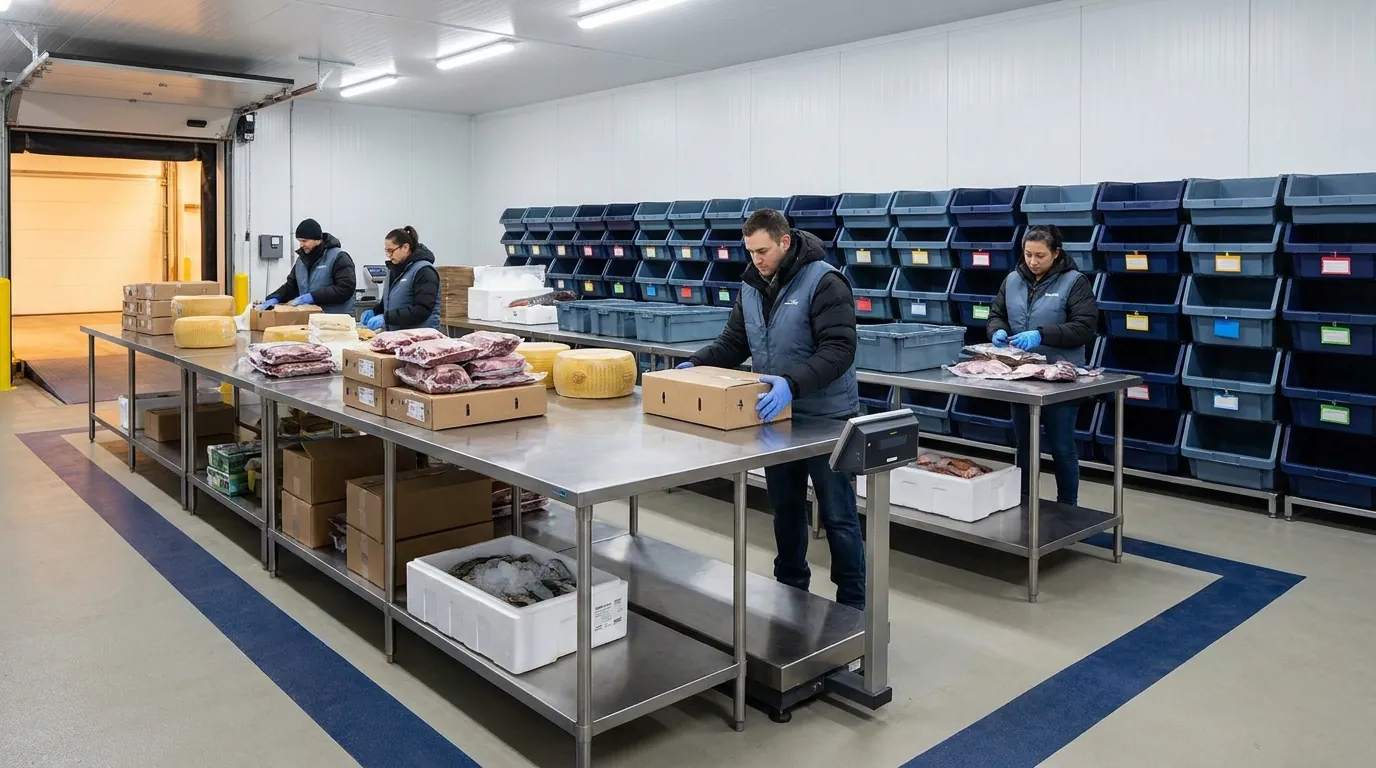
Pricing logic matters, but the floor is where variable-weight accuracy is decided. Each time a case moves, the right weight must stay attached to the right unit, lot and order. Here is our 40.8 lb chicken case from dock to cycle count, guided by one principle: capture weight once, accurately and early, then carry it with the unit.
Receiving and Put-Away
- Scan the inbound label. A supplier GS1-128 label with a weight Application Identifier records 40.8 lb, the lot and the date without a scale.
- Weigh unlabeled cases on an integrated scale so the reading posts directly to the receipt. Avoid hand-keying.
- Check the advance ship notice (ASN) and flag case counts or total pounds outside tolerance before signing.
- Assign a license plate that links each pallet or case to its weights, lot and expiration date, then put away by FEFO (first-expired, first-out).
Picking: Scan vs Weigh
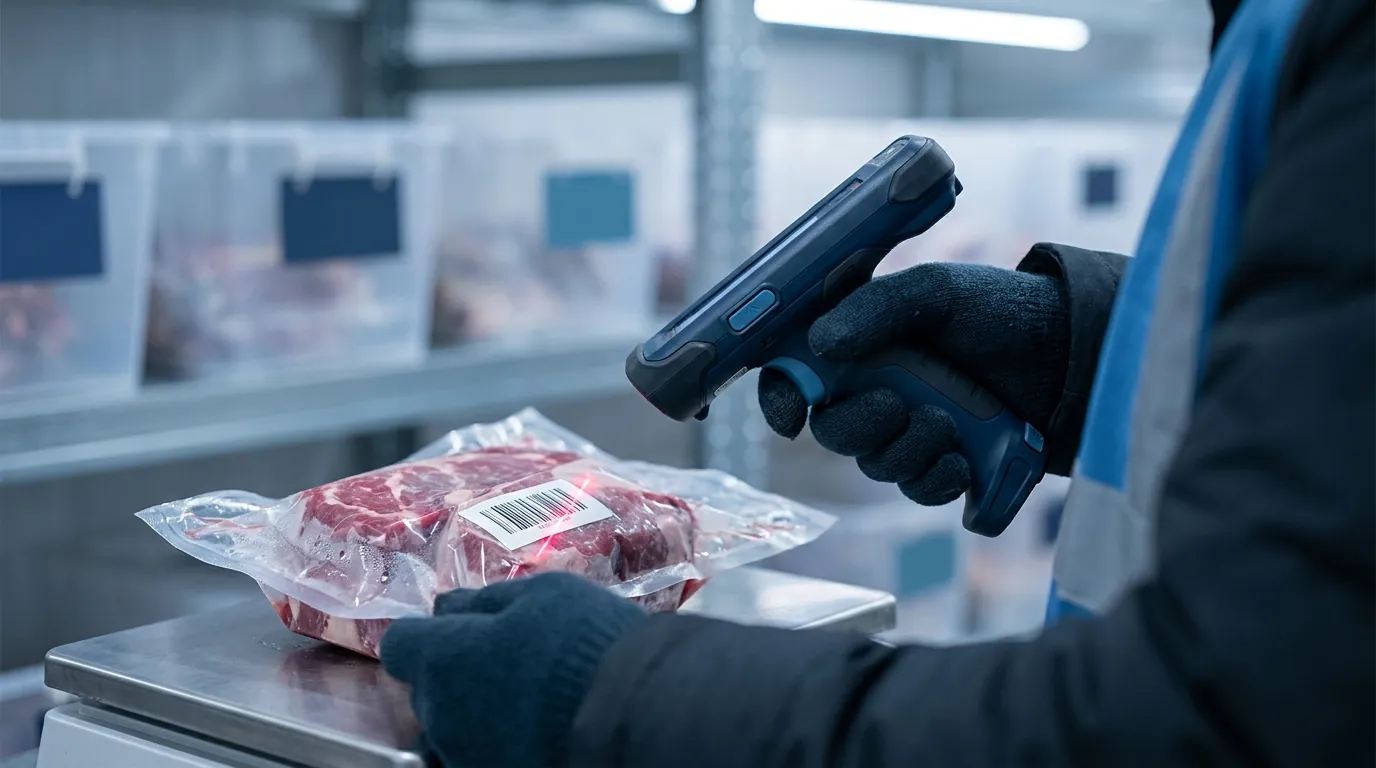
Scanning reads the embedded weight from each case label. It is fast when every case carries its net weight. Weighing is required for unlabeled product, broken cases or cut-to-order items. Most food distributors combine the two. Either way, the system should validate weight against tolerance and confirm FEFO lot order before closing the line.
GS1-128 Barcodes with AI 310n and 320n
AI 310n encodes net kilograms, and AI 320n encodes net pounds. The final digit, n, sets the decimal position. Our case reads (3201)000408 for 40.8 lb or (3103)018507 for 18.507 kg. These usually sit beside AI (01) for a variable-measure GTIN (often starting with indicator digit 9), AI (10) for lot, and a date AI such as (13) pack date or (17) expiration. Every downstream scan then captures weight without re-weighing.
Shipping, Invoicing and Cycle Count Reconciliation
- Shipping: confirm cases and total pounds per order, and print a manifest listing each case's weight and lot.
- Invoicing: pass actual shipped weights to billing so the invoice reflects 412.6 lb, not the 400 lb estimate. How that handoff works depends on your back-office stack. For background, see how ERP and MRP systems differ.
- Cycle count: count units, re-weigh or re-scan a sample, investigate variances and post corrections with a reason code. Because catch weight stock is usually valued by the pound, reconciling both measures protects inventory valuation.
A Brief Compliance Note
NIST Handbook 130 holds model packaging and labeling regulations that many states adopt, and Handbook 133 covers net contents inspection. USDA FSIS governs meat and poultry labeling. FDA covers most other foods under 21 CFR 101.105. Commercial scales generally must meet NIST Handbook 44 as adopted by states. Rules vary by product and jurisdiction, so confirm specifics with your regulatory or legal team.
Managing Catch Weight with a WMS
The earlier sections apply to any operation, whatever software it runs. This part looks at the role a warehouse management system can play for food and beverage manufacturers, distributors, cold-storage operators and 3PLs that handle variable-weight product.
A WMS designed for this work can hold inventory in two measures at once: units and weight. A carton of chicken thighs can exist as one case and as 40.8 lb, with both figures changing together whenever it moves. Operators can capture the weight where the work happens, either by scanning the carton's GS1-128 label or by reading a connected scale. The platform can then keep that reading tied to the license plate, lot number and expiry as the carton travels from dock to put-away, picking and final shipment.
When actual weights follow each carton out the door, the numbers billing pulls match what the customer physically received. Spreadsheets and ERP-only setups often leave this gap open, because a weight written down at the dock never makes it to the invoice. Clean weight history also helps beyond billing. Planners forecasting demand for random-weight items can work from pounds actually sold instead of rough case-count estimates.
Temperature adds another layer. Proteins, seafood and dairy usually sit in coolers or freezers, where purge and moisture loss slowly change weights between receipt and shipment. If your facility runs refrigerated zones, the basics of cold storage cover the handling practices that keep that product safe and sellable.
During evaluation, run your own items through a scripted scenario. Receive a pallet that mixes labeled and unlabeled cases, pick a broken case, ship an order and then count the location. Watch whether each weight stays consistent from step to step without anyone retyping it.
What a Catch-Weight-Capable WMS Should Do
Whatever platform you evaluate, hold it to these requirements:
- Track a counting UoM and a pricing UoM on every item, location and transaction
- Parse GS1-128 application identifiers 310n (net weight in kilograms) and 320n (net weight in pounds), along with lot and date AIs, during receiving and picking
- Connect to floor and bench scales so workers rarely key weights by hand
- Enforce weight tolerances for each item and route out-of-range readings to an exception workflow
- Support FEFO allocation and full lot traceability for fast recall response
- Send real shipped weights to invoicing rather than nominal ones
- Reconcile both cases and pounds during cycle counts, with reason codes that explain shrink
Request a Demo to see ASC Software's WMS for yourself.
Frequently Asked Questions
What does catch weight mean?
Catch weight is the real net weight captured on the scale for one specific unit of a variable-weight product, such as a case of chicken or a wheel of cheese. The item is counted in units but priced by weight. For example, a case with a nominal weight of 40 lb might read 40.8 lb, and the customer is billed for 40.8 lb.
Is catch weight the same as net weight?
In most operations, yes. Catch weight is gross weight minus tare, which is how net weight is defined. The difference is that it gets measured and stored for each individual unit rather than declared ahead of time on a label. A case weighing 43.4 lb gross with 2.6 lb of packaging has a catch weight of 40.8 lb.
How is a catch weight invoice calculated?
The order is first estimated using nominal weight, then the invoice is finalized using weights captured at picking or shipping. For example, 10 cases at a nominal 40 lb and $3.85/lb are estimated at $1,540.00. If those cases actually total 412.6 lb, the final invoice comes to $1,588.51, a difference of $48.51.
Which GS1-128 barcode identifiers store catch weight?
AI 310n encodes net weight in kilograms and AI 320n encodes net weight in pounds, with the final digit setting the decimal position. A 40.8 lb case would read (3201)000408. These usually appear alongside AI (01) for the GTIN, AI (10) for lot and a date identifier such as (17) for expiration, so later scans capture weight without re-weighing.
What should a WMS do to handle catch weight products?
It should track a counting unit and a pricing unit on every item and transaction, then send real shipped weights to invoicing. Look for GS1-128 parsing of AIs 310n and 320n, scale integration to avoid hand-keyed entries, per-item tolerances such as 38 to 42 lb for a 40 lb case, FEFO allocation and cycle counts that reconcile both cases and pounds.